
How to Spell Believe
Is it beleive, or believe?
Common Misspellings:
📊 Google Trends: Avg 2.4 daily searches (Sept-Dec 2025) - consistent demand for IE vs EI clarification
You're Not Alone
The "I before E except after C" rule has confused generations of English speakers, and "believe" is one of the most common casualties. The rule suggests "beleive" should be correct (since there's no C), but it's actually an exception. This spelling trick will help you remember the right spelling forever.
Why This Mistake Happens
"I before E except after C" rule confusion: This famous spelling rule suggests that without a C, you should use IE. But "believe" is an exception - it uses IE even though the rule would predict EI. When you overapply the rule, you end up with "beleive."
Multiple common misspellings: People misspell "believe" in several ways: "beleive" (wrong order), "belive" (missing E), and "beleave" (confusing with "leave"). The pronunciation "buh-LEEV" doesn't clearly indicate which vowels go where, so people guess.
Visual similarity to other words: Words like "achieve" and "receive" use different patterns, creating confusion. "Achieve" has IE after H, "receive" has EI after C. Without a clear pattern, "believe" seems arbitrary - until you know the spelling trick.
Word Origin
"Believe" comes from Old English "gelēfan" (to have faith in, trust). The prefix "ge-" was a collective marker, and "lēfan" meant "to allow" or "to hold dear." The IE spelling pattern came from Middle English orthography conventions, not from phonetic logic - which is why the "I before E except after C" rule doesn't apply here.
Etymology Path:
Old English gelēfan → Middle English bileven → Modern English believe
The Spelling Trick
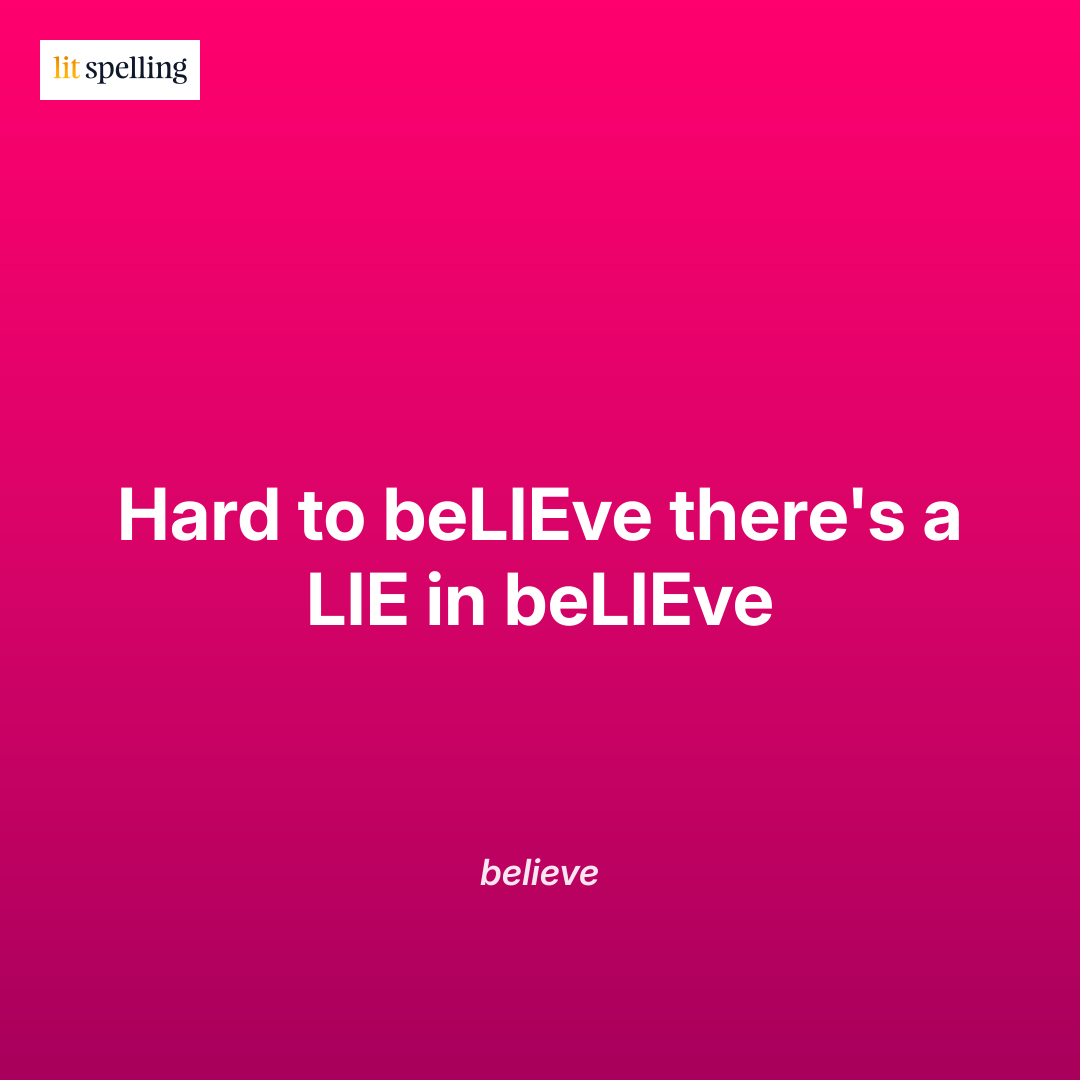
"Hard to beLIEve there's a LIE in beLIEve"
Why it works: This spelling trick creates meta-level irony - it's hard to believe (trust) when there's a lie (falsehood) embedded in the word itself. The contradiction is memorable and emotionally sticky. Once you picture "LIE" hidden inside "beLIEve," you'll never forget the IE pattern.
How to use it: When you're typing "believe" and hesitate on the vowel order, recall: "Hard to beLIEve there's a LIE in beLIEve." The word "LIE" appears clearly, showing you it's L-I-E, not L-E-I.
Examples in Context
Casual: "I can't believe how fast this year went by!"
Professional: "We believe this strategy will increase revenue by 15%."
Personal: "I believe in giving people second chances."
Skeptical: "Do you really believe that story?"
Philosophical: "What you believe shapes how you see the world."
Common Mistakes to Avoid
✗ beleive - Wrong vowel order (applying "I before E" rule incorrectly)
✗ belive - Missing E entirely (shortening based on pronunciation)
✗ beleave - Wrong ending (confusing with "leave")
Quick tip: Forget the "I before E except after C" rule for this word. Instead, remember there's a "LIE" in "beLIEve" - that locks in the L-I-E pattern. Related words like "relieve" and "disbelieve" follow the same -LIEVE pattern, always with IE.