How to Spell Calendar
Is it calender, or calendar?
Common Misspellings:
📊 Google Trends: Avg 56.3 daily searches (Sept-Dec 2025) - #2 most-searched spelling question | Peak: 100 in December (planning season)
You're Not Alone
This is the #2 most commonly misspelled word according to Google Trends data, with searches peaking dramatically in December when people are buying and planning calendars for the new year. The confusion between 'A' and 'E' in the unstressed syllable is completely understandable - and there's a simple memory trick that makes it stick.
Why This Mistake Happens
Vowel reduction (schwa sound): When you say "calendar" out loud, the middle vowel becomes a neutral "uh" sound (called a schwa in linguistics). It sounds like "CAL-en-der," which makes it natural to think it's spelled with an 'E' rather than an 'A'.
Similar word patterns: English has many -ER ending words (cylinder, container, remainder), so your brain expects that pattern. The -AR ending feels less common, even though it's correct for Latin-derived words like calendar, grammar, and collar.
The Latin root isn't obvious: Unless you know that "calendar" comes from Latin "calendarium" (with three A's), the spelling seems arbitrary. Once you see the pattern - calendAR records DAys and yeARs - it makes perfect sense.
Word Origin
"Calendar" entered English in the 13th century from Latin "calendarium," which originally meant "account book" or "register." The Romans named it after the "calendae" (kalends), the first day of each month when accounts were due and interest was paid. The Latin "calendae" came from "calare" meaning "to call out" or "to proclaim," because the start of each month was publicly announced in ancient Rome.
Etymology Path:
Latin calendarium → Middle English calender → Modern English calendar
The Spelling Trick
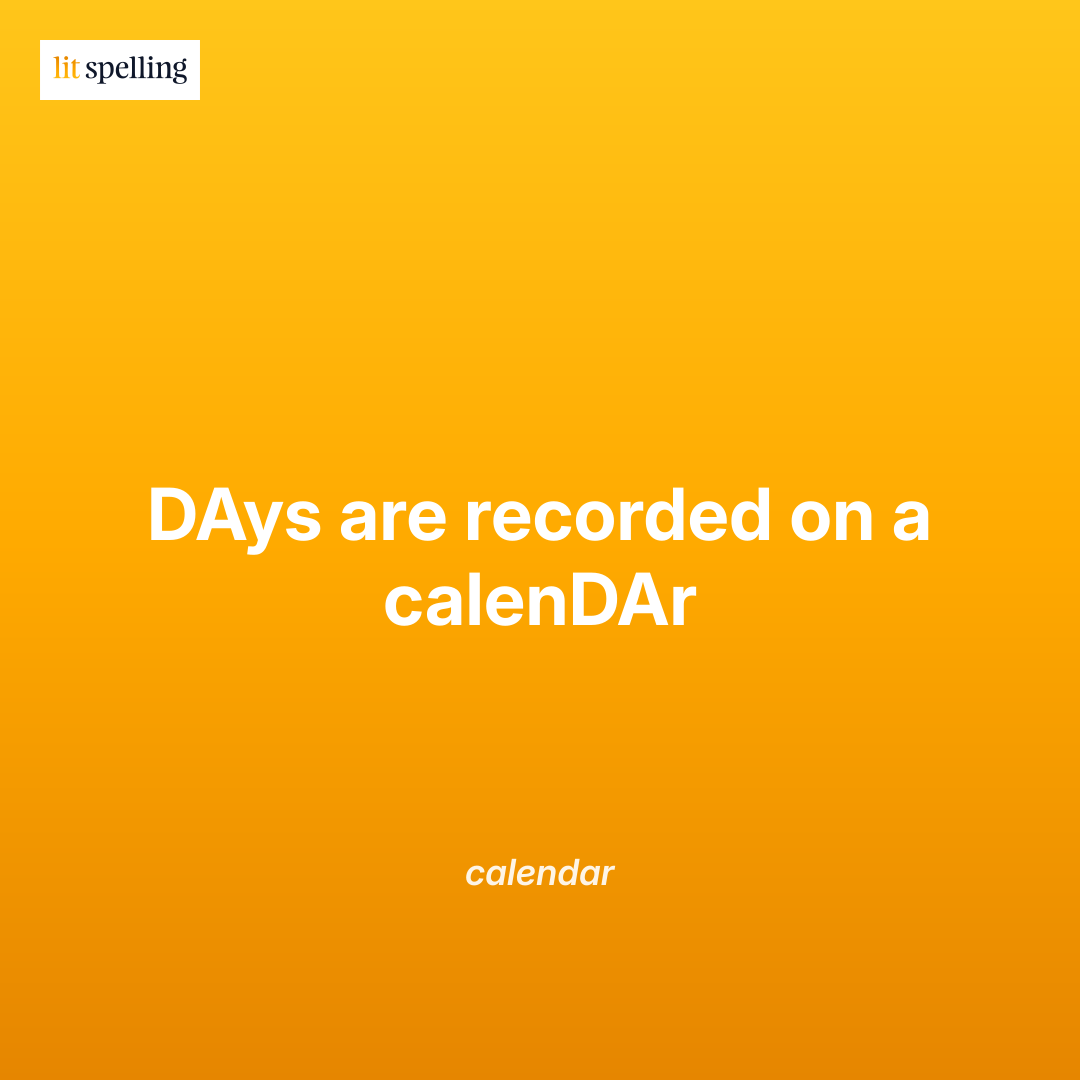
"DAys are recorded on a calendAR"
Why it works: This spelling trick shows you the 'A' pattern three times: DAys → calendAR. It connects the spelling to meaning (calendars record days), making it logical rather than arbitrary. The pattern DAR helps you remember the correct vowel.
How to use it: When you're writing "calendar" and pause at the middle vowel, recall: "DAys are recorded on a calendAR." The parallel structure (DAys/calendAR) locks in the 'A' spelling naturally.
Examples in Context
Planning: "I marked your birthday on my calendar for next month."
Professional: "Let me check my calendar and get back to you with available dates."
Academic: "The school calendar shows finals week starts December 10th."
Historical: "The Gregorian calendar was introduced by Pope Gregory XIII in 1582."
Digital: "Sync your appointments across all devices with a shared calendar."
Common Mistakes to Avoid
✗ calender - Wrong vowel (most common error, influenced by pronunciation)
✗ calandar - Wrong vowel in first syllable (less common but happens)
✗ calander - Swapped vowels (mixing up the pattern)
Quick tip: Remember that "calender" IS a real word - but it's a machine that smooths fabric, not what you use to track dates. For days, months, and years, it's always "calendar" with three A's. Think: calendAR tracks DAys and yeARs.