
Practice vs Practise: US vs UK Spelling
Is it practise, or practice?
Common Misspellings:
📊 One of the most confusing US vs UK spelling differences - regional variation matters
You're Not Alone
The practice/practise confusion is one of the most common regional spelling differences between American and British English. Even native speakers from one region make mistakes when writing for audiences in another region. The challenge is that both spellings are correct - it just depends on your location and whether you're using it as a noun or verb. The confusion is completely understandable.
Why This Mistake Happens
Regional variation in spelling standards: American English uses "practice" for everything, while British/Australian English uses "practise" for verbs and "practice" for nouns. If you learned one system but write for the other region, your default spelling will be flagged as incorrect.
No phonetic difference between C and S: "Practice" and "practise" sound identical when spoken. There's no acoustic cue to tell you which spelling is appropriate, so you can't rely on pronunciation to guide your choice.
Noun/verb distinction isn't obvious: In British English, you need to work out whether you're using the word as a noun or verb before choosing C or S. This grammatical review adds an extra mental step that's easy to skip when writing quickly, leading to errors even among British writers.
Word Origin
"Practice" entered English in the 15th century from Old French "practiser" and Medieval Latin "practicare" (to practice, perform). The word comes from Greek "praktikos" (practical) and "praxis" (deed, action). Originally, English used "practise" for the verb and "practice" for the noun (following the advice/advise pattern), but American English simplified to "practice" for both.
Etymology Path:
Greek praxis → Medieval Latin practicare → Modern English practice/practise
The Spelling Trick
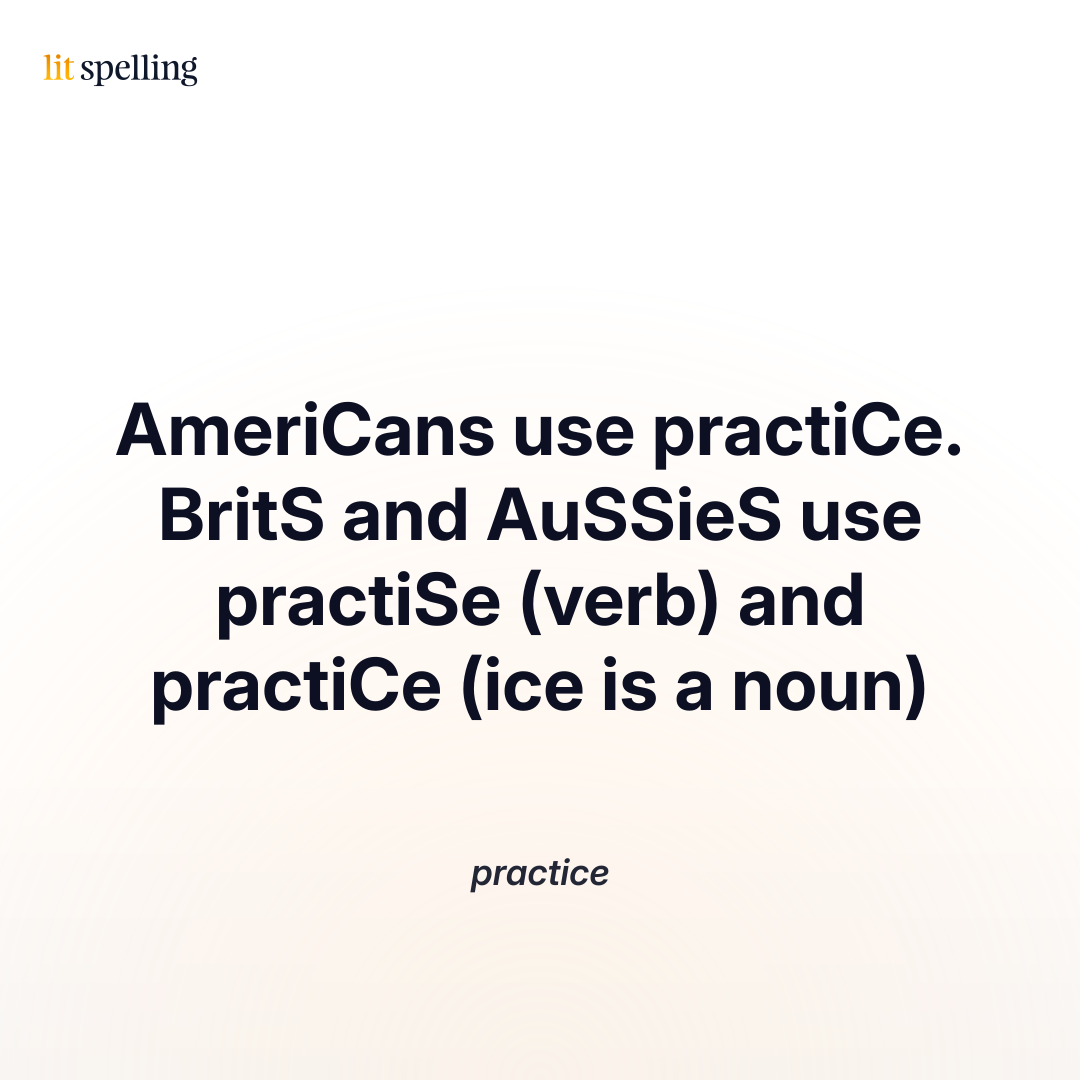
"AmeriCans use practiCe. BritS and AuSSieS use practiSe (verb) and practiCe (iCe is a noun)"
Why it works: This spelling trick encodes all the rules in one sentence. "AmeriCans" and "practiCe" both have C, showing Americans always use C. "BritS" and "AuSSieS" have S, connecting to "practiSe" for the verb. The final part "iCe is a noun" connects the C spelling to the noun form, making the pattern memorable.
How to use it: When writing "practice/practise," first identify your audience's region. If American, always use C. If British/Australian, check if you're using it as a verb (use S) or noun (use C). Think: "Ice is a noun, so practice (noun) gets C."
Examples in Context
US (noun): "Daily practice improves your spelling skills."
US (verb): "I practice spelling for 15 minutes every day."
UK (noun): "The doctor's practice is on High Street."
UK (verb): "You should practise your presentation before the meeting."
AU (mixed): "If you practise regularly, your practice sessions become more effective."
Common Mistakes to Avoid
✗ practise (US) - Using S in American English (always use C)
✗ "I practice law" (UK) - Using C for verb in British English (should be "practise")
✗ "The practise is closed" (UK) - Using S for noun in British English (should be "practice")
Quick tip: Know your audience. If writing for Americans, always use "practice" with C. If writing for British/Australian readers, remember: iCe is a noun (practice), while verbs take S (practise). When in doubt, check which English variety your style guide requires.