
How to Spell Pronunciation
Is it pronounciation, or pronunciation?
Common Misspellings:
You're Not Alone
This is one of the most commonly misspelled words in English, even among language teachers and professional writers. The confusion is completely natural - we have "pronounce" with NOUN, so why wouldn't "pronunciation" follow the same pattern? The answer lies in Latin etymology, but the spelling trick below makes it simple.
Why This Mistake Happens
Logical but incorrect pattern matching: We have the verb "pronounce" (with NOUN), so people naturally assume the noun is "pronounce + ation = pronounciation." This logical error happens because we expect related words to share spelling patterns.
Different Latin origins: "Pronunciation" comes from Latin "pronuntiatio" (with NUNTIA), while "pronounce" took a slightly different path through French. They're related in meaning but have different spelling roots, which creates the confusion.
The NOUN trap: Your brain sees "NOUN" in "pronounce" and wants to carry that pattern forward. It's a perfectly logical assumption - just historically incorrect. The spelling trick below helps you override this intuition.
Word Origin
"Pronunciation" entered English in the late 14th century from Latin "pronuntiatio" (a proclamation, announcement), from the verb "pronuntiare" (to announce, proclaim). The Latin word combines "pro-" (forth, out) with "nuntiare" (to announce). The NUN pattern is original to the Latin root - notice it's NUNTIA, not NOUNCIATION. The verb "pronounce" took a parallel but separate path through Old French "pronuncier."
Etymology Path:
Latin pronuntiatio (pro- + nuntiare) → Old French pronunciation → Modern English pronunciation
The Spelling Trick
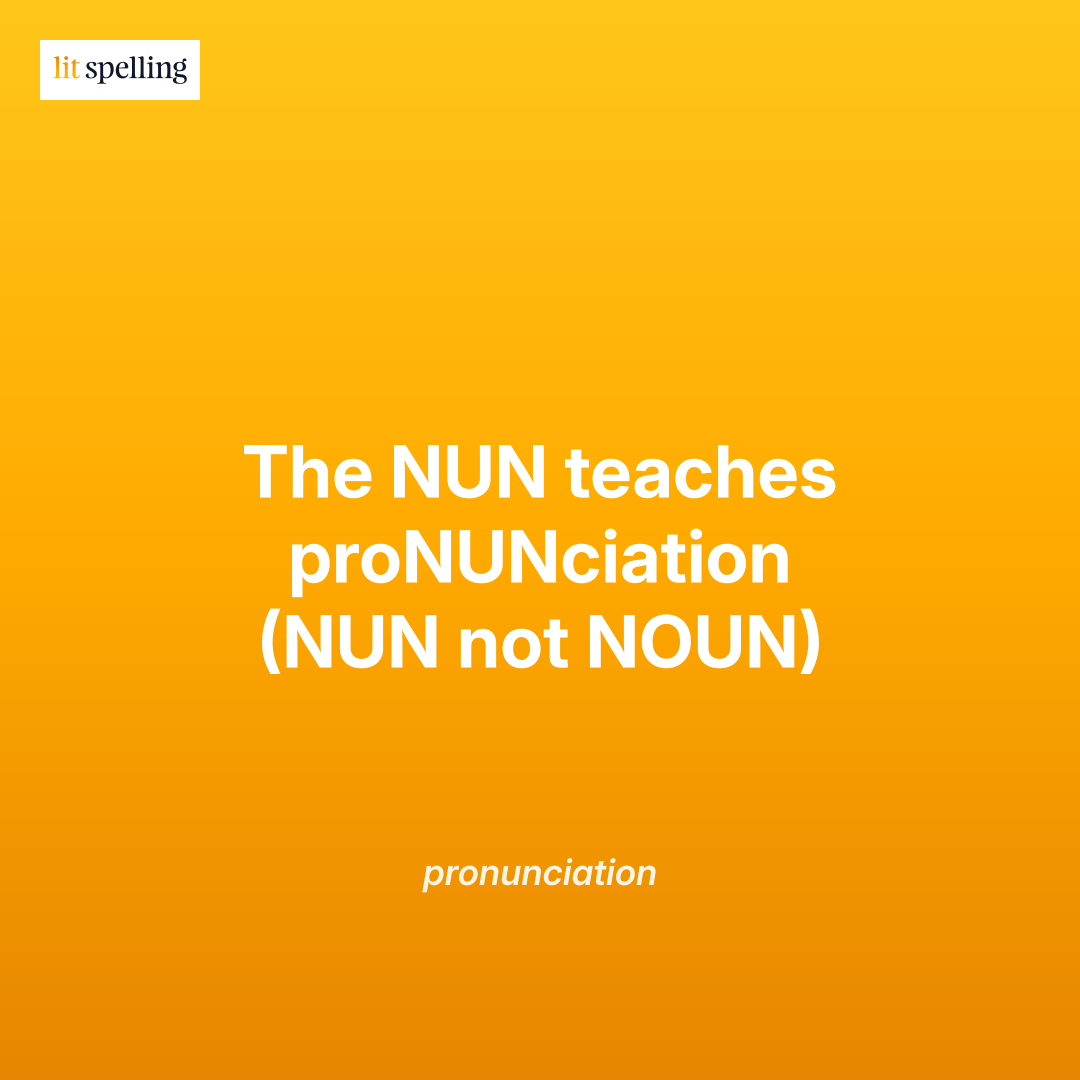
"The NUN teaches proNUNciation (NUN not NOUN)"
Why it works: This spelling trick creates a clear visual contrast between the incorrect NOUN pattern and the correct NUN pattern. The image of a teacher (nun) instructing you on the correct spelling makes it memorable and connects to the word's meaning (teaching proper speech).
How to use it: When you're writing "pronunciation" and your fingers want to type "NOUN," recall the scene: "The NUN teaches proNUNciation." The teaching context reinforces the lesson, and the NUN vs. NOUN contrast is impossible to forget.
Examples in Context
Educational: "The teacher corrected my pronunciation of 'mischievous.'"
Linguistic: "British and American pronunciation differ significantly."
Instructional: "Check the dictionary for the correct pronunciation."
Descriptive: "Her pronunciation was clear and precise."
Professional: "The speech therapist worked on pronunciation exercises."
Common Mistakes to Avoid
✗ pronounciation - Using NOUN instead of NUN (most common error, logical but incorrect)
✗ prononciation - Missing U after O (influenced by French spelling)
✗ pronunciaton - Missing I before A (typing error)
Quick tip: If you remember that "pronunciation" comes from the Latin NUNTIA root (to announce) - not from "pronounce" - the NUN pattern makes perfect sense. Think of related words: annunciation, enunciation, denunciation - all use NUNCI-.