
How to Spell Separate
Is it seperate, or separate?
Common Misspellings:
📊 Google Trends: Avg 12.4 daily searches (Sept-Dec 2025) - Steady performer with no seasonal variation
You're Not Alone
"Separate" is one of the most consistently misspelled words in English, with steady daily searches showing this is a universal challenge. The vowel reduction (schwa sound) makes it nearly impossible to hear the correct "A" when you say "SEP-uh-rate" out loud. You're not careless - you're battling natural pronunciation patterns. The RAT mnemonic will fix this forever.
Why This Mistake Happens
Vowel reduction (schwa sound): When you say "separate" naturally, the middle vowel reduces to a neutral "uh" sound called a schwa. It sounds like "SEP-uh-rate," not "SEP-ay-rate." Since the schwa sounds like "E," your brain writes "seperate" instead of "separate." This is one of the most common spelling traps in English.
Visual confusion with "desperate": The word "desperate" has a similar structure (vowel-R-vowel) but uses E-R-A, not A-R-A. Your brain sees "desperate" (which is spelled correctly with E) and applies the same pattern to "separate," creating "seperate." But they're different words with different roots - desperate uses E, separate uses A.
No clear pronunciation cue: Unlike words where you can hear the vowel clearly (like "rate" or "fate"), the middle vowel in "separate" is unstressed and unclear. There's no audible signal telling you it's an A, so you have to learn it by heart - or use a mnemonic that makes the A visible and memorable.
Word Origin
"Separate" comes from Latin "separare" (to divide, part, sever), which combines "se-" (apart) and "parare" (to prepare, make ready). The Latin root "parare" gave us other English words like "prepare" and "repair." The "A" in "separate" comes directly from the Latin "parare," which is why it's spelled with an A even though it sounds like E in modern English pronunciation.
Etymology Path:
Latin separare → Middle English separaten → Modern English separate
The Spelling Trick
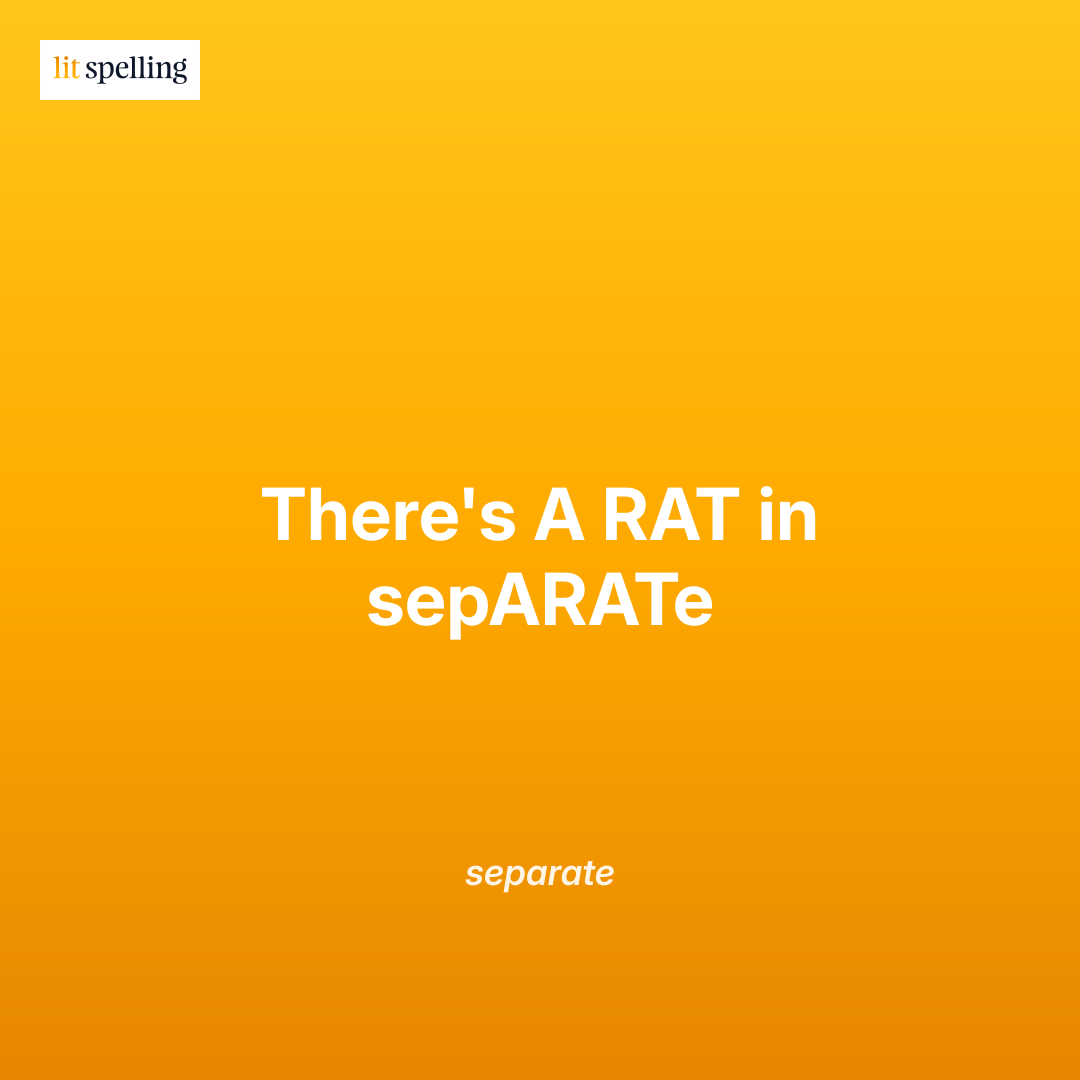
"There's A RAT in sepARAte"
Why it works: This is one of the most famous spelling mnemonics in English - and for good reason. The word "RAT" is literally hidden inside "sepARAte" (sep-A-R-A-te), showing you the exact A-R-A pattern you need to remember. The visual image is strong: you'd want to separate yourself from a rat. It's concrete, memorable, and directly addresses the error point (A vs E).
How to use it: When you're typing "separate" and hesitate at the middle vowel, picture the RAT hidden inside the word: sep-A-R-A-te. The image of a rat (something you'd separate yourself from) reinforces both the spelling and the meaning. Once you see the RAT, you'll never spell it "seperate" again.
Alternative Mnemonics
- "PAR means 'equal' (like par in golf) - separate things are on par" - shows the PAR pattern (sep-A-R-ate)
- "A rat separates the 'sep' from the 'ate'" - narrative version highlighting the A-R-A structure
Examples in Context
Household: "Please separate the recyclables from the trash."
Legal: "The couple decided to live in separate apartments during the trial period."
Professional: "We need to separate personal opinions from business decisions."
Academic: "The study examined each variable separately to isolate effects."
Philosophical: "It's impossible to separate art from the artist's lived experience."
Common Mistakes to Avoid
✗ seperate - Wrong vowel (most common error, follows pronunciation)
✗ seprate - Missing middle A entirely (overcorrection)
✗ seperete - Wrong pattern (confusing with other words)
Quick tip: Don't confuse "separate" with "desperate" - they have different roots and different vowel patterns. "Desperate" uses E-R-A (from Latin "desperare"), while "separate" uses A-R-A (from Latin "separare"). The RAT mnemonic works only for "separate" and its related words (separately, separation).