
How to Spell Surprise
Is it suprise, or surprise?
Common Misspellings:
You're Not Alone
The "suprise" misspelling is extremely common, especially in casual writing. The first R is often unstressed in speech, making it easy to forget when typing quickly. This is a natural mistake that happens to confident writers - and it's completely fixable with the right memory trick.
Why This Mistake Happens
Unstressed first R: When you say "surprise" naturally, the first R can sound subtle or almost silent - like "suh-PRIZE." This makes it easy to think the word is spelled with just one R.
Pattern confusion with similar words: English has many words where the spelling doesn't match the pronunciation exactly - like "price," "prize," and "precise" - all spelled without a U-R combination. Your brain might default to this more common pattern.
Fast typing muscle memory: When typing quickly, it's easy to skip the first R because the finger movement from S to P feels more natural than S-U-R-P. The muscle memory for "suprise" can override the correct spelling.
Word Origin
"Surprise" entered English in the 15th century from Old French "surprise" (a taking unawares), which came from the verb "surprendre" meaning "to overtake." The French word combines "sur-" (over, upon) with "prendre" (to take). The word originally meant "to take over" or "to seize suddenly," and developed the modern meaning of an unexpected event or feeling.
Etymology Path:
Old French surprendre (sur- + prendre) → Middle French surprise → Modern English surprise
The Spelling Trick
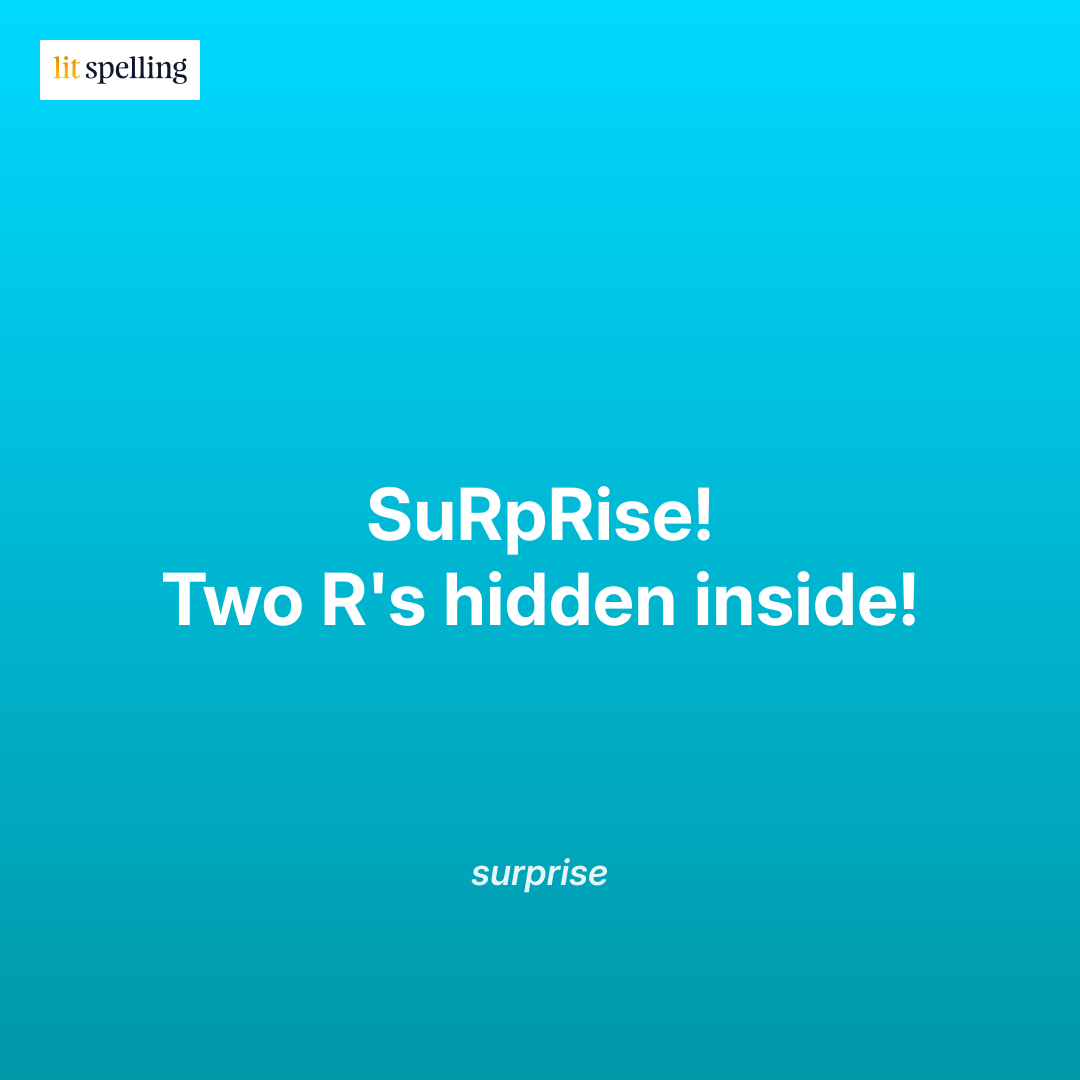
"SuRpRise! Two R's hidden inside!"
Why it works: The exclamation "Surprise!" naturally fits the word's meaning, and capitalizing both R's (suRpRise) makes them visually prominent. The phrase "two R's hidden inside" creates a memorable insight that rewires your spelling.
How to use it: When you're typing "surprise" and hesitate, recall the exclamation: "SuRpRise! Two R's hidden inside!" The surprise element and the visual emphasis on both R's ensure you remember the correct spelling.
Examples in Context
Casual: "I have a surprise birthday party planned for you!"
Professional: "The quarterly results were a pleasant surprise to the board."
Emotional: "Her reaction was a mix of shock and surprise."
Narrative: "To my surprise, the store was already closed."
Descriptive: "It came as no surprise that she won the award."
Common Mistakes to Avoid
✗ suprise - Missing first R (most common error, influenced by pronunciation)
✗ surprize - Using Z instead of S (influenced by "prize")
✗ surpise - Missing second R (rare typing error)
Quick tip: Think of the prefix SUR- (meaning "over" or "above"). All SUR- words keep both letters: surpass, surround, survive, surplus, and surprise. The R is part of the prefix structure.