How to Spell Tomorrow
Is it tommorow, or tomorrow?
Common Misspellings:
📊 Google Trends: Avg 10.7 daily searches (Sept-Dec 2025) - Reliable, consistent demand
You're Not Alone
"Tomorrow" is one of the most commonly misspelled words, with consistent daily searches showing this confusion is universal. The phonetic emphasis on "MORR" (with the strong double-R sound) tricks your brain into thinking both consonants should be doubled. You're not making a careless error - you're following what you hear. The good news? This spelling trick will lock in the correct pattern forever.
Why This Mistake Happens
Phonetic doubling: When you say "tomorrow" naturally, it sounds like "tuh-MORR-oh" with heavy emphasis on the "MORR" syllable. The double-R sound is so strong and clear that your brain assumes the M should be doubled too. You're spelling what you hear - "TOM-MORR-OW" - rather than the historical structure "TO-MORROW."
Compound word confusion: Most people don't know "tomorrow" is historically a compound of "to" + "morrow." Without understanding the structure, the letter pattern seems arbitrary. Why one M but two Rs? Once you see it's TO (one M) joined to MORROW (two Rs), the spelling makes perfect sense.
Common typing error (muscle memory): When typing quickly, muscle memory can double the M because it's right before the emphatic double-R. Your fingers want to mirror the pattern: if there are two Rs, there should be two Ms. But the structure doesn't work that way - it's one M from "to," then two Rs from "morrow."
Word Origin
"Tomorrow" comes from the Middle English phrase "to morwe" or "to morow," meaning "on the morrow" (on the morning/next day). "Morrow" is an Old English word for "morning" or "the next day," derived from "morgen" (morning). Over time, "to morrow" merged into the single word "tomorrow." This etymology explains why there's only one M - it's the "to" prefix (one M) joined to "morrow" (two Rs). The structure is TO-MORROW, not TOM-MORROW.
Etymology Path:
Old English to morgen → Middle English to morwe → Modern English tomorrow
The Spelling Trick
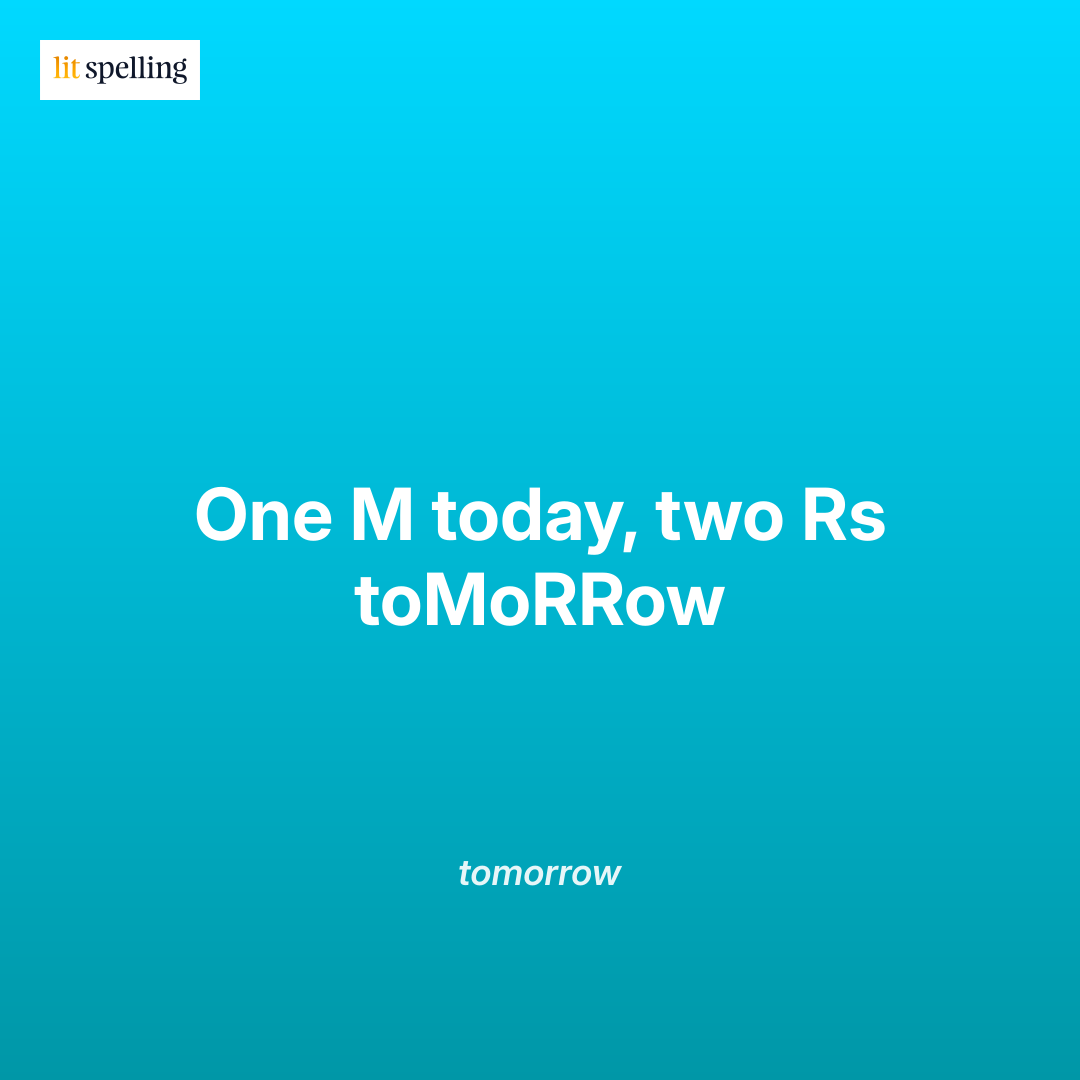
"One M today, two Rs toMoRRow"
Why it works: This spelling trick uses a visual letter count to show the exact pattern: one M (for today), then two Rs (for tomorrow). The contrast between "today" and "toMoRRow" makes the structure memorable. It's concrete, countable, and addresses the exact error point (how many Ms vs how many Rs).
How to use it: When you're typing "tomorrow" and pause at the consonants, recall: "One M today, two Rs toMoRRow." Count the letters as you type: T-O-M (one M), then O-R-R (two Rs), then O-W. The rhythm locks in the pattern naturally.
Alternative Mnemonics
- "TOM will come toMORROW (Tom + orrow)" - shows the split between the name TOM and the suffix ORROW
- "ToMorrow has one M for today, two Rs for the future" - temporal metaphor linking letter count to meaning
Examples in Context
Planning: "I'll finish the report tomorrow morning."
Casual: "Let's talk about this tomorrow - I'm too tired right now."
Professional: "The deadline is tomorrow at 5 PM, so please submit by then."
Philosophical: "Don't put off until tomorrow what you can do today."
Weather: "Tomorrow's forecast shows rain in the afternoon."
Common Mistakes to Avoid
✗ tommorow - Double M (most common error, follows phonetic emphasis)
✗ tommorrow - Both double M and double R (overcorrection)
✗ tomarrow - Wrong vowel (mixing up the pattern)
Quick tip: Remember the historical compound structure: TO + MORROW. The word "to" has one M, and "morrow" has two Rs. When you join them, you get TO-M-O-R-R-OW. Don't double the M just because the R is doubled - they come from different parts of the compound word.