
How to Spell Which
Is it wich, or which?
Common Misspellings:
📊 Google Trends: Avg 18.8 daily searches (Sept-Dec 2025) - Very stable, consistent demand
You're Not Alone
This is one of the most commonly confused homophones in English. Google Trends shows consistent daily searches for "which" vs "wich" - the silent H tricks even confident writers. When you can't hear the difference, it's natural to second-guess the spelling. The good news? Once you learn the WH-question word pattern, you'll never forget it.
Why This Mistake Happens
Silent H confusion: In modern English pronunciation, "which" sounds identical to "wich" - the H is completely silent. When you say "which one?" out loud, there's no audible H sound, so your brain doesn't register it when spelling.
Homophone interference: The word "witch" (a person who practices magic) is spelled without the WH pattern, creating confusion. Your brain knows "witch" exists, so "wich" seems like a plausible spelling for the question word too.
Common typing error: When typing quickly, muscle memory can drop the H, especially since it's silent. The extra keystroke (H) doesn't match the sound you hear in your head, so it feels redundant - but it's not. The H is part of the historical WH-question word family.
Word Origin
"Which" comes from Old English "hwilc," which combined "hwa" (who) and the suffix "-lic" (like, body). The original pronunciation had a breathy 'H' sound before the 'W', but over centuries, English speakers stopped pronouncing the H distinctly. The spelling preserved the historical WH pattern, which is why all English question words (what, when, where, why, which, who) start with WH, even though the H is now silent.
Etymology Path:
Old English hwilc → Middle English which → Modern English which
The Spelling Trick
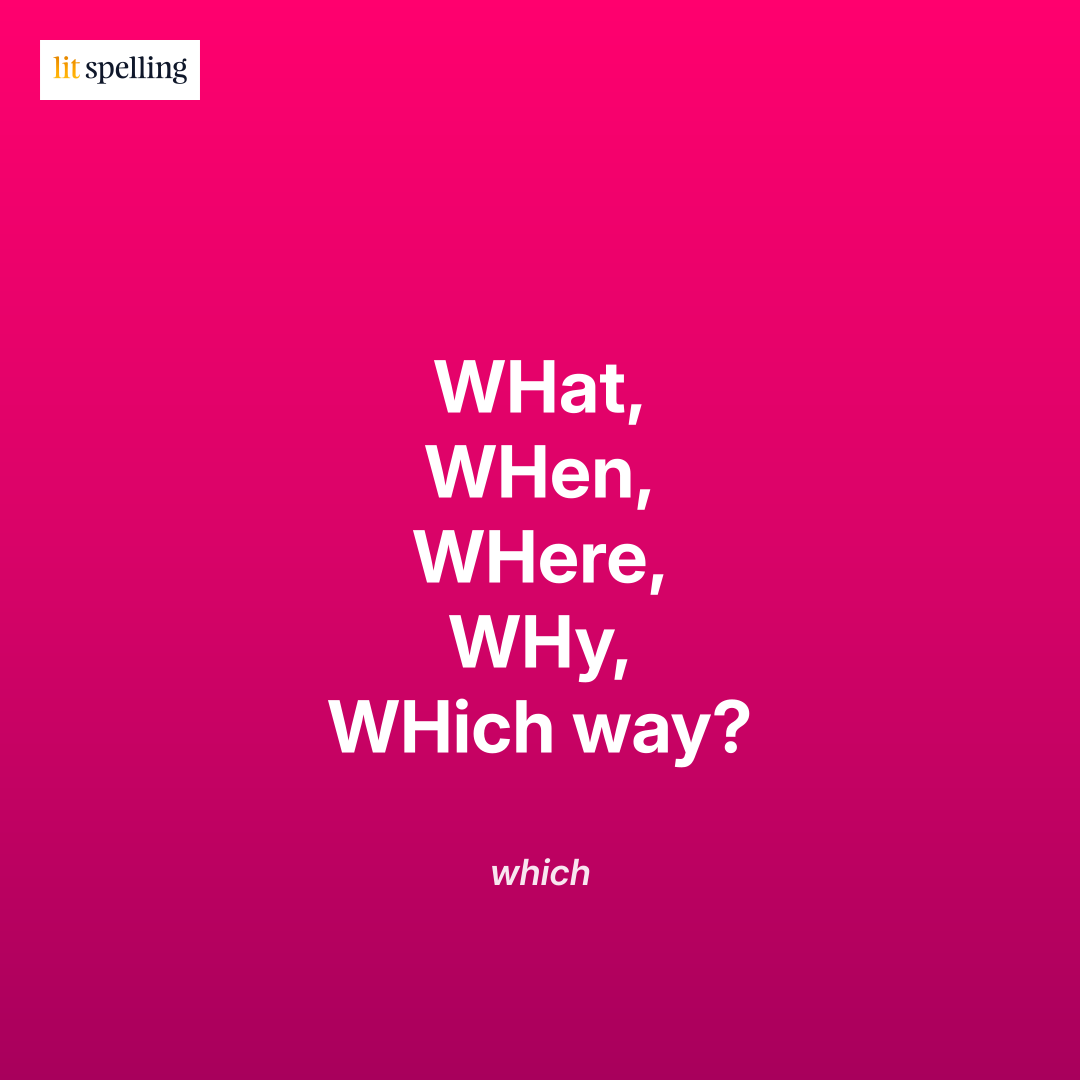
"What, when, where, why, which way?"
Why it works: This spelling trick shows you that "which" belongs to the WH-question word family. The rhythm is memorable, and seeing all five question words together (what, when, where, why, which) makes the pattern obvious. All question words start with WH, never just W.
How to use it: When you're typing "which" and pause at the H, recall this sequence: "What, when, where, why, which way?" The rhythm reminds you that "which" shares the WH DNA with all the other question words. The H isn't optional - it's part of the family.
Examples in Context
Choosing: "Which color do you prefer - blue or green?"
Identifying: "Which car is yours in the parking lot?"
Specifying: "I don't know which route to take."
Professional: "Which candidate would you recommend for the position?"
Relative clause: "The book which I recommended is on sale now."
Common Mistakes to Avoid
✗ wich - Missing H (most common error, follows pronunciation)
✗ witch - Confusing with the magic person (different word entirely)
✗ whitch - Adding extra letters (overcorrection)
Quick tip: All question words start with WH: what, when, where, why, which, who. If you're asking a question to choose or identify something, use the WH pattern. "Witch" (magic person) is the exception - it's not a question word, so it doesn't follow the WH rule.