
How to Spell Absence
Is it absense, or absence?
The correct spelling is absence - -ENCE at the end, not -ENSE. It's commonly misspelled as absense, abscence, or absance.
Absence means the state of being away or not present - the absence of something is the lack or want of it.
Common Misspellings:
Why Absence Is Hard to Spell
You're not alone. Absence trips up writers because its ending sounds exactly like the word "sense" - making "absense" feel intuitively correct. The C in -ENCE is completely silent in speech, so there's no audio cue to remind you it's there.
Why this mistake happens: English has two similar-sounding endings: -ENCE (science, presence, existence) and -ENSE (sense, dense, intense). They're pronounced almost identically in unstressed syllables, so the ear can't distinguish them. The trick is grouping "absence" with the -ENCE family - not the -ENSE family.
Absence Spelling Breakdown
Break it into chunks: ab-s-ence
Notice the pattern: AB + SENCE - the SENCE part is the same ending as in sciENCE, presENCE, and existENCE. The AB- prefix means "away from" - absence is literally "away-ness." And away-ness ends in -ENCE, not -ENSE.
Word Origin
"Absence" comes from Latin "absentia" - from "absens," the present participle of "abesse" (to be away). AB- means "away from" and ESSE means "to be," so absence literally means "the state of being away." It entered English via Old French "absence" in the 14th century. The -ENCE ending comes directly from the Latin -ENTIA suffix, shared by presence, science, and existence.
Etymology Path:
Latin absentia → Old French absence → Modern English absence
Memory Trick for Absence
Use this simple phrase to lock in the correct spelling forever:
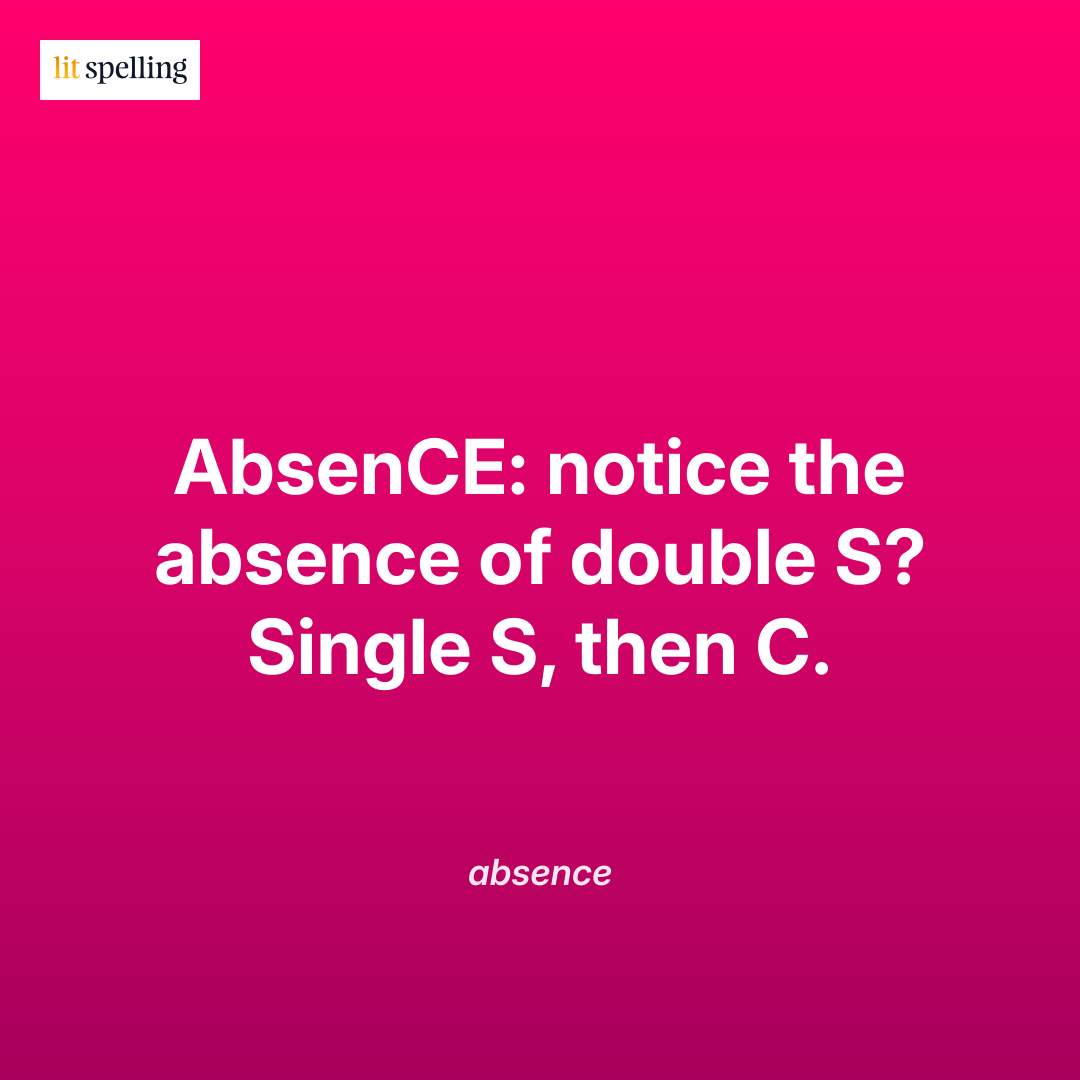
"AbsenCE: notice the absence of double S? Single S, then C."
Why it works: The paradox is the point - "no SENSE" is a deliberate misdirect that highlights exactly which word you should not be spelling. AbSENCE uses -ENCE (like sciENCE), not -ENSE (like SENSE). The contrast makes the correct pattern unforgettable.
How to use it: When you hesitate at "absen_e," ask: "Is it like sciENCE or like SENSE?" It's like sciENCE - so write the C: ab-s-ENCE. Also try: presence, existence, science - absence fits right in. None of those have an S at the end; they all have C-E.
What Absence Means
Absence means the state of being away or not present - the absence of something is the lack or want of it.
School: "Her absence from class was noted in the register."
Abstract: "The report highlighted the absence of clear guidance on the matter."
Common Misspellings of Absence
✗ absense - Ends in -ENSE (like "sense"), but absence uses -ENCE (like "science")
✗ abscence - Extra C inserted before -ENCE; there is only one C, at the end
✗ absance - Replaces the E in -ENCE with an A; the suffix is -ENCE not -ANCE
Quick tip: Group absence with science, presence, existence - all -ENCE words. None end in -ENSE, -ANCE, or double-C.
