
How to Spell Beginning
Is it begining, or beginning?
The correct spelling is beginning - double N in the middle, not single. It's commonly misspelled as begining, beggining, or biginning.
Beginning means the point in time or space at which something starts - the first part or early stage of something.
Common Misspellings:
Why Beginning Is Hard to Spell
You're not alone. Beginning is one of the most misspelled common words in English. The root "begin" is spelled correctly by almost everyone - but the doubling rule for adding -ING is easy to forget, especially because not all words follow it (opening, offering, happening all keep a single consonant).
Why this mistake happens: English doubles the final consonant only when the last syllable is stressed and follows a consonant-vowel-consonant pattern. "Begin" ends in stressed G-I-N, so N doubles. But "open" ends in an unstressed syllable, so opening stays single. Most people don't know this rule - they just have to remember which words double.
Beginning Spelling Breakdown
Break it into chunks: be-gin-n-ing
Or: BEGIN + N + ING. The root word "begin" (b-e-g-i-n) gives you the first five letters. The double N is the join point - one N from "begin," one N from the -ING suffix attaching. After the double N: just -ING.
Word Origin
"Beginning" comes from Old English "beginnan" - from be- (intensive prefix) + ginnan (to begin, to open). The word has been in continuous use since Old English, making it one of the oldest common verbs in the language. The -ING form naturally developed as the present participle, and the consonant-doubling rule is a Middle English phonological inheritance that keeps the root vowel short and clear.
Etymology Path:
Old English beginnan → Middle English biginning → Modern English beginning
Memory Trick for Beginning
Use this simple phrase to lock in the correct spelling forever:
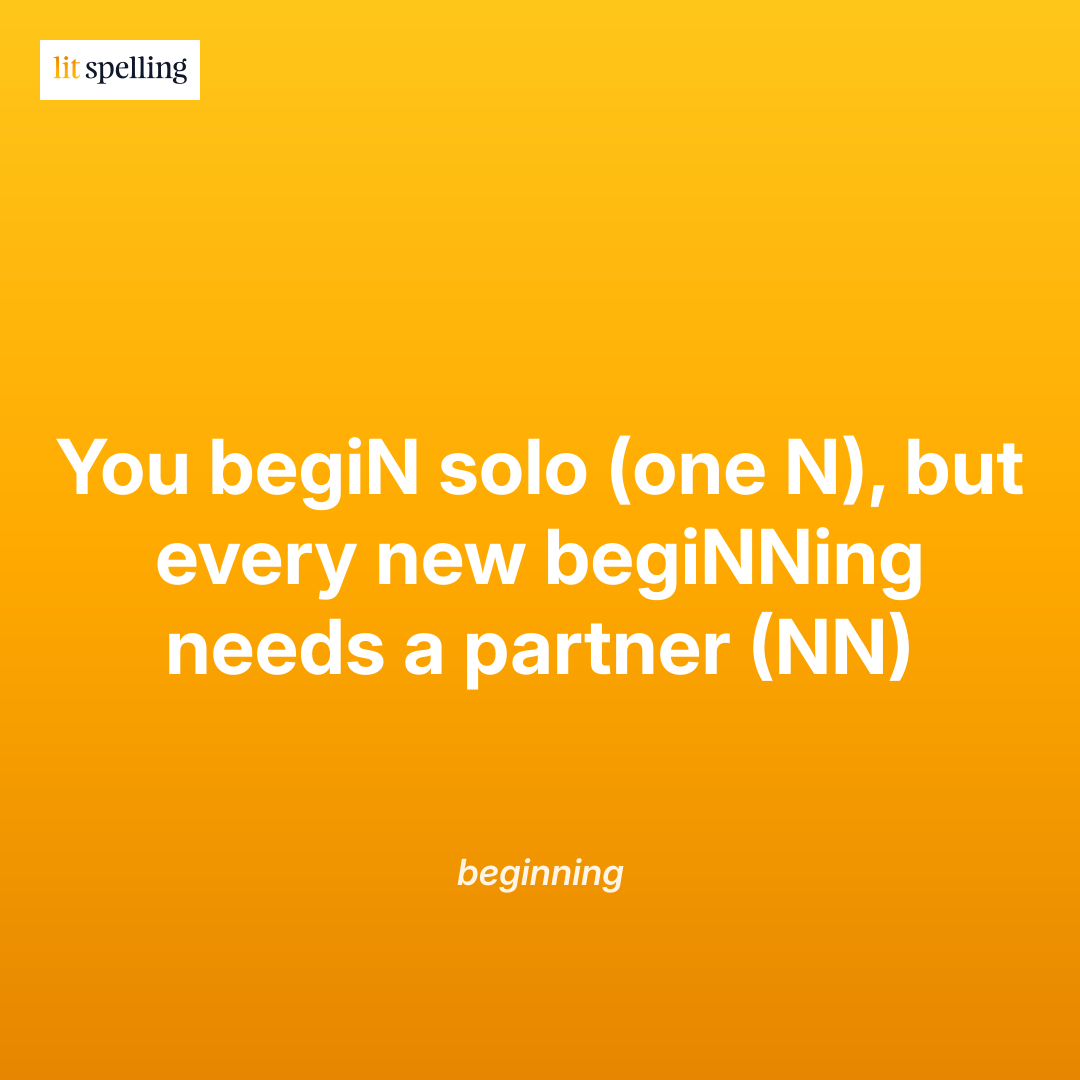
"You begiN solo (one N), but every new begiNNing needs a partner (NN)"
Why it works: "Begin" ends with a solo N - that's your starting N. The moment you add -ING, that N gets a partner: begiN + N + ing. The image of a solo beginning turning into a paired partnership makes the double N feel logical and memorable.
How to use it: When you hesitate on "beginn_ing," ask: "does the N have a partner?" Yes - every new beginning needs two Ns. Spell it: b-e-g-i-n-n-i-n-g. The same mental image works for other doubling words: running, swimming, sitting.
What Beginning Means
Beginning means the point in time or space at which something starts - the first part or early stage of something.
Time: "From the beginning of the year, they committed to daily practice."
Idiom: "Every expert was once a beginning."
Common Misspellings of Beginning
✗ begining - Single N; the consonant-doubling rule requires NN when adding -ING to "begin"
✗ beggining - Doubles the G instead of the N; only the final consonant of the stressed syllable doubles
✗ biginning - Wrong vowel in first syllable; the root is "begin" (BE-), not "bigin"
Quick tip: Begin + N + ing - spell "begin" first (you know that), then add an extra N before -ing. That's all there is to it.