
How to Spell Business
Is it buisness, or business?
The correct spelling is business - U before I, not I before U. It's commonly misspelled as buisness, bussiness, or busines.
Business means a person's work, trade, or commercial enterprise - also an affair or matter that concerns someone.
Common Misspellings:
Why Business Is Hard to Spell
You're not alone. Business is one of the most frequently misspelled words in professional writing. The "busi-" syllable is pronounced "bizz-" - and that short I sound makes the brain reach for I first, producing "buisness" instead of "business."
Why this mistake happens: The root is the word "busy" (b-u-s-y), but when "-ness" is added the Y drops and pronunciation shifts to "bizz-ness." The original U-S-I order from "busy" becomes invisible once the sound changes. Anchoring on BUS restores the correct order.
Business Spelling Breakdown
Break it into chunks: bus-i-ness
Three clear parts: BUS (b-u-s) + I + NESS. The BUS is the anchor - it's always B-U-S, never B-I-S or B-U-I-S. After BUS comes I, then the familiar -NESS suffix (like happiness, fitness, witness). Eight letters total: B-U-S-I-N-E-S-S.
Word Origin
"Business" comes from Old English "bisigness" - from "bisig" (busy, anxious, careful) plus "-ness." In Middle English it was "bisyness," meaning anxiety or concern. The meaning shifted from personal anxiety to commercial activity around the 16th century. The pronunciation changed faster than the spelling: "busy" shifted to a short-I sound ("bizzy") while the written form preserved the original U from Old English.
Etymology Path:
Old English bisigness → Middle English bisyness → Modern English business
Memory Trick for Business
Use this simple phrase to lock in the correct spelling forever:
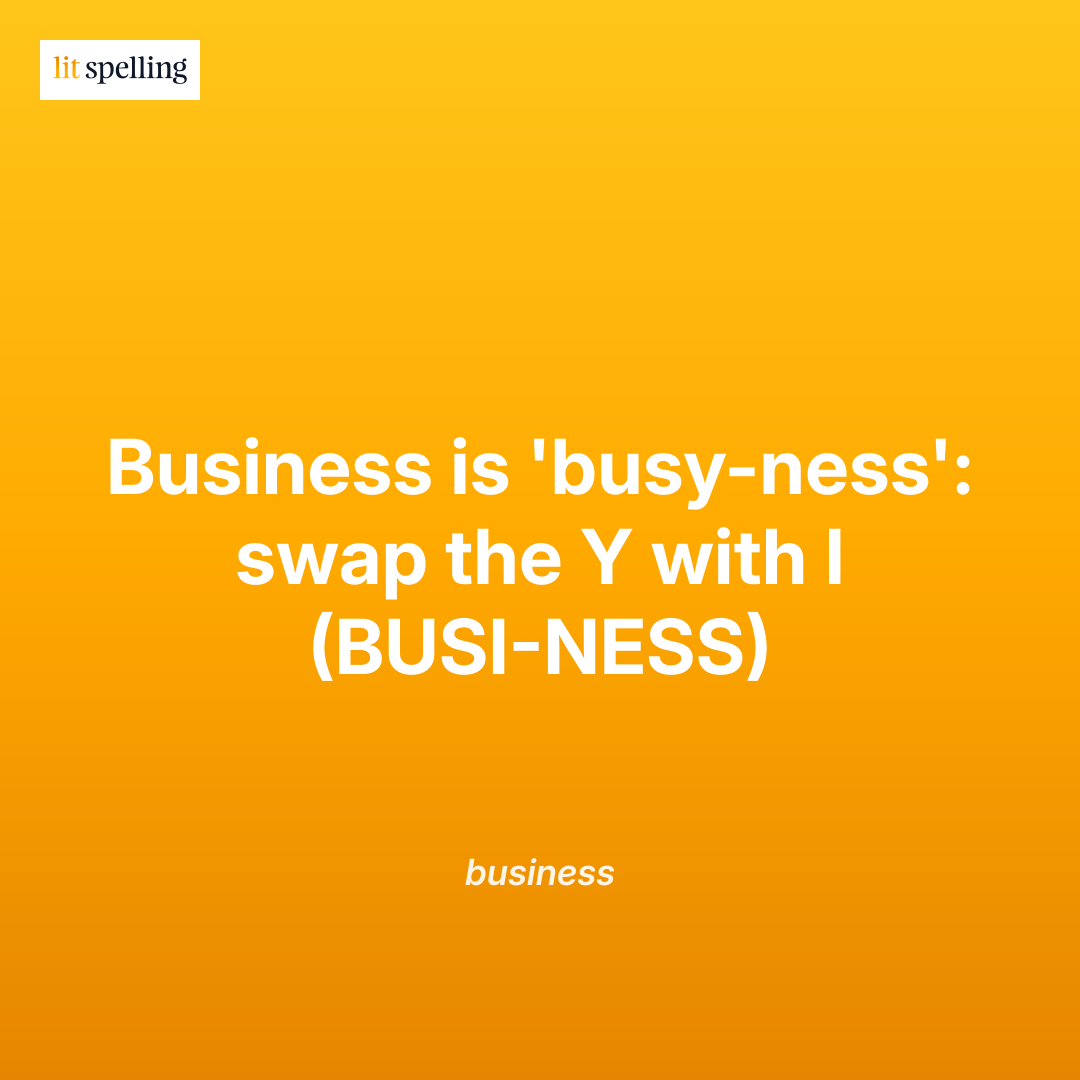
"Business is 'busy-ness': swap the Y with I (BUSI-NESS)"
Why it works: BUS is a real word you already know, and it's the first three letters of business in the correct order: B-U-S. A bus is always on the move - always busy. Once BUS is locked in, I (the passenger) and NESS (the destination) follow naturally.
How to use it: When you start writing "business," picture a bus: write BUS first (b-u-s), not BIS or BUIS. Then add I and NESS. If you hesitate on the vowel order, ask: "does a BUS start with U or I?" U - always U. B-U-S.
What Business Means
Business means a person's work, trade, or commercial enterprise - also an affair or matter that concerns someone.
Commerce: "She started her own business selling handmade ceramics."
Idiom: "Mind your own business - this doesn't concern you."
Common Misspellings of Business
✗ buisness - Swaps U and I; the BUS always starts B-U-S, not B-U-I-S
✗ bussiness - Doubles the S after BU; the first S belongs to BUS (one S), not BUSS
✗ busines - Drops one S from the -SS ending; business ends in double S, like witness and fitness
Quick tip: BUS + I + NESS - three parts, eight letters. The BUS anchor locks in the U-before-I order every time.