
How to Spell Harassment
Is it harrassment, or harassment?
The correct spelling is harassment with one R and two S's. It's commonly misspelled as harrassment, harasment, or harassement.
Harassment is persistent, unwanted conduct or pressure directed at a person that causes distress, particularly in workplace or social settings.
Common Misspellings:
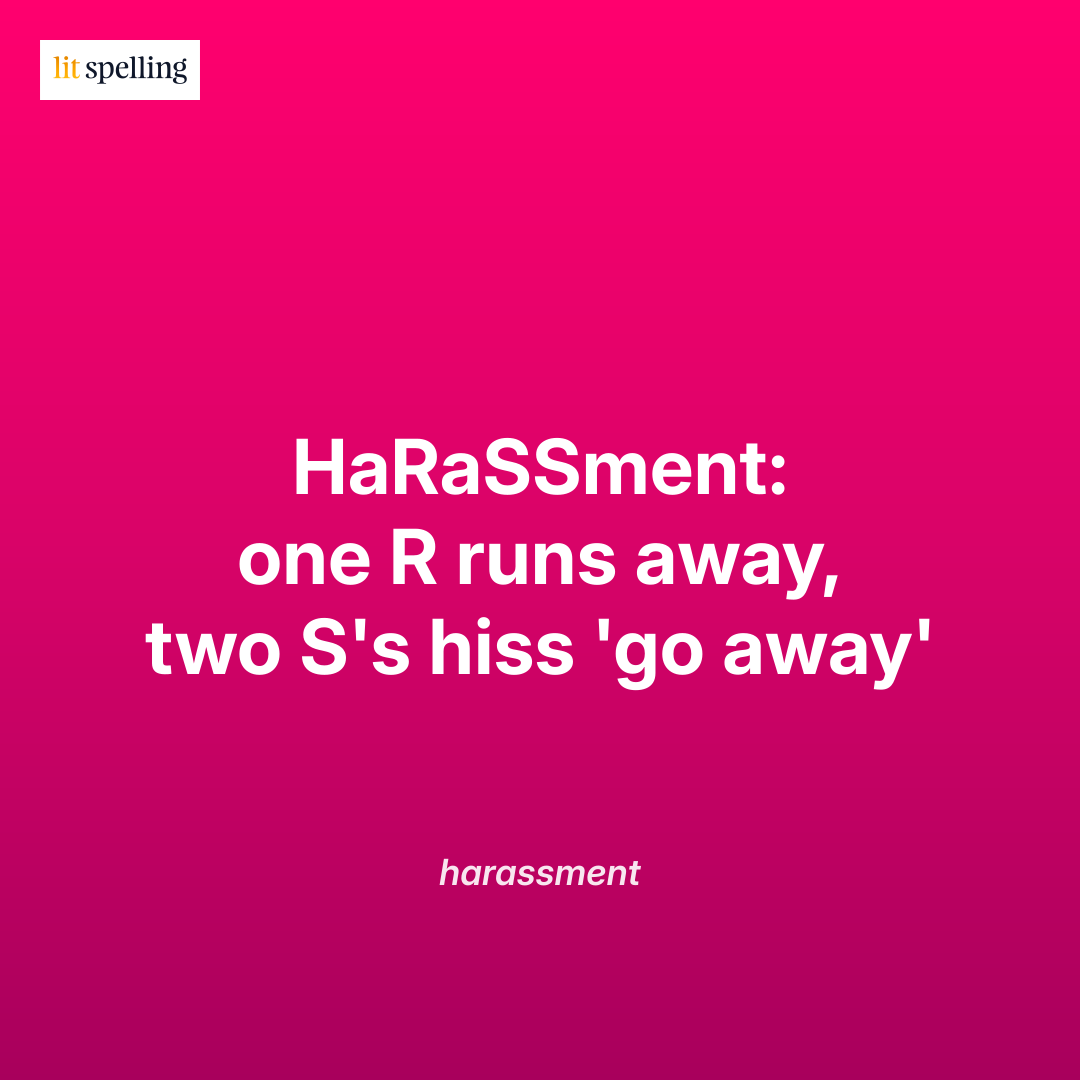
Why Harassment Is Hard to Spell
You're not alone. Harassment consistently ranks among difficult professional vocabulary words. The similar word "embarrass" has BOTH double R and double S, which leads many writers to assume "harassment" also has double R. But "harass" only doubles the S, not the R - and this natural confusion trips up even strong spellers.
Why this mistake happens: The word "embarrass" (double R, double S) creates a misleading mental template. When writing "harassment," many writers automatically add a second R they remember from "embarrass." The mnemonic captures this perfectly: one R runs away, leaving two S's to do the hissing.
Harassment Spelling Breakdown
Break it into chunks: ha-rass-ment
Notice the pattern: ha-RaSSment - one R, then two S's. The root "harass" has single R and double S. Adding "-ment" never changes the root spelling - focus on locking in ha-RASS first.
Word Origin
"Harassment" comes from French "harasser" - to tire out or exhaust through persistent attack - likely derived from Old French "harer" (to set a dog on someone). The word entered English in the mid-1600s with the sense of wearing down an enemy. The double S preserves the intensive pattern from French "harasser." Unlike "embarrass" (which doubles both R and S from its own French roots), "harass" inherited only the double S - which is why harassment has one R but two S's.
Etymology Path:
French harasser → Old French harer → Modern English harassment
Memory Trick for Harassment
Use this simple phrase to lock in the correct spelling forever:
"HaRaSSment: one R runs away, two S's hiss 'go away'"
Why it works: This trick creates a vivid scene: one R "runs away" from the word, leaving just one lonely R, while two S's "hiss" like snakes saying "go away." The double-S sound is literally a hiss - reinforcing the image. Once you picture the single R trying to escape while two S's hold their ground, the 1-R, 2-S pattern locks in permanently.
How to use it: When you write "harassment" and hesitate at the consonants, picture one R running while two S's hiss. Ask yourself: "Did R get away? Yes - just one R. Are the S's staying? Both of them." Count: one R, two S's. The SS is the aggressive part of the word - and it always comes in pairs.
What Harassment Means
Harassment is persistent, unwanted conduct or pressure directed at a person that causes distress, particularly in workplace or social settings.
Workplace: "The company updated its anti- harassment policy to cover online conduct as well."
Legal: "The court found that the repeated unwanted contact constituted harassment under the statute."
Common Misspellings of Harassment
✗ harrassment - Extra R added (confused with "embarrass" which has double R AND double S)
✗ harasment - Missing one S (dropped a letter from the double SS in "harass")
✗ harassement - Extra E inserted between "harass" and "-ment"
Quick tip: Remember "one R runs away" - unlike embarrass (double R, double S), harass only doubles the S. Harassment = ha-R-a-SS-ment: one R, two S's.
