How to Spell Millennium
Is it millenium, or millennium?
The correct spelling is millennium with double L and double N. It's commonly misspelled as millenium, milennium, or millenniem.
A millennium is a period of one thousand years, often used to mark significant historical transitions or major calendar milestones.
Common Misspellings:
Why Millennium Is Hard to Spell
You're not alone. Millennium trips up even strong spellers because it contains two separate pairs of double letters - and you have to remember both. Most people nail either the double L or the double N, but rarely both on the first try. This is a genuine cognitive challenge, not carelessness.
Why this mistake happens: The word is built from two Latin parts: "milli-" (thousand, as in millimetre - double L) and "-ennium" (year, from Latin "annum" - double N). Writers who know the "milli-" prefix often forget the double N, and vice versa. "Millenium" (one N) is the most common error because the "-ennium" suffix is less familiar.
Millennium Spelling Breakdown
Break it into chunks: mil-len-ni-um
Notice the two pairs: milLLeNNium - double L from the "milli-" prefix (like millimetre), double N from "-ennium" (Latin "annum," meaning year). Both pairs come from their Latin roots and both must stay.
Word Origin
"Millennium" was formed from two Latin words: "mille" (one thousand, as in millimetre and million) and "annum" (year, as in annual and anniversary). Renaissance scholars combined them into "millennium" in Modern Latin, referring originally to the thousand-year reign described in Christian eschatology. The word entered English in the mid-1600s. The double L preserves "milli-" (same as in millimetre and millipede) and the double N preserves the "-enn-" from "annum." Both doublings come directly from their Latin roots - neither is optional.
Etymology Path:
Latin mille + annum → Modern Latin millennium → Modern English millennium
Memory Trick for Millennium
Use this simple phrase to lock in the correct spelling forever:
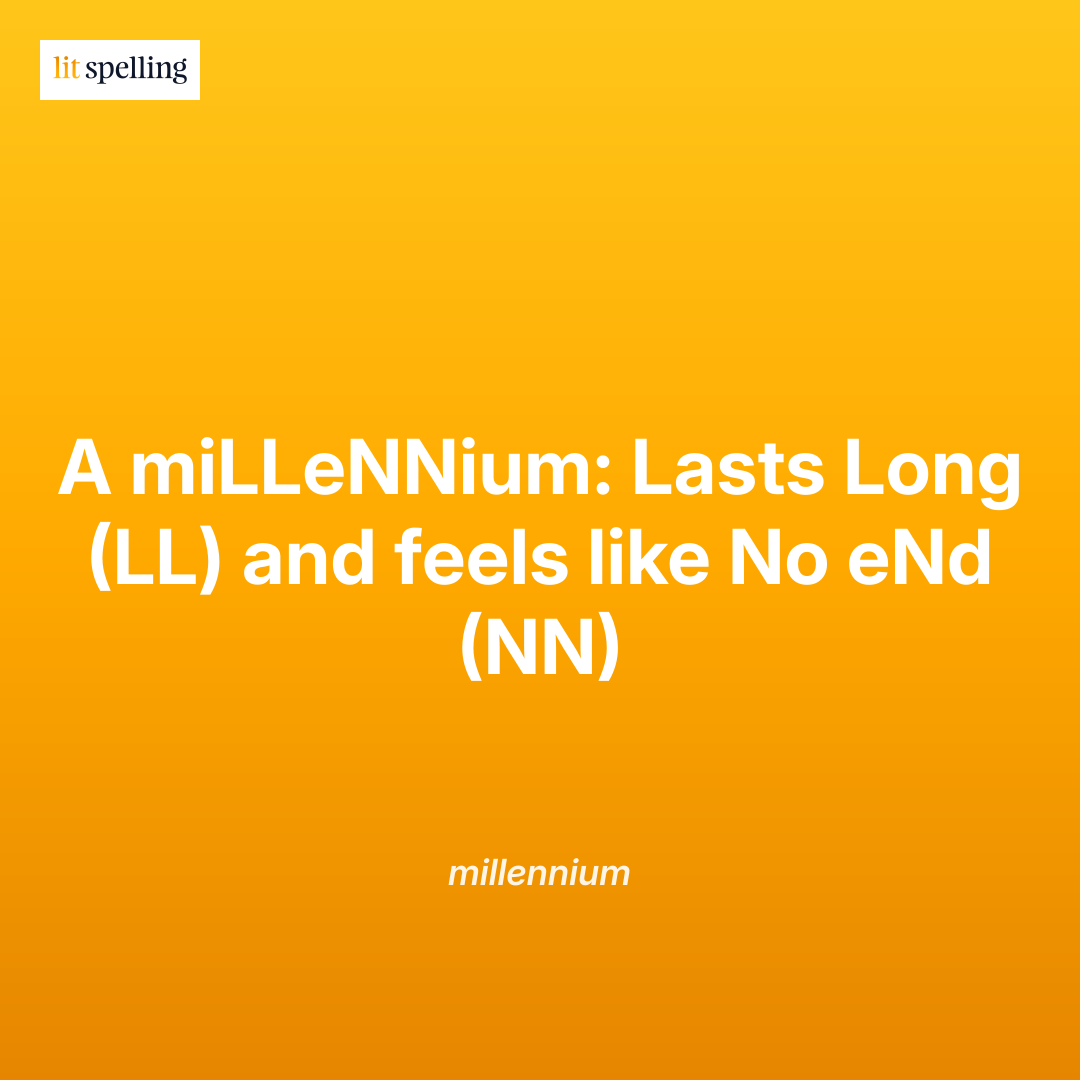
"A miLLeNNium: Lasts Long (LL) and feels like No eNd (NN)"
Why it works: The mnemonic points directly at both pairs: LL "Lasts Long" and NN "No eNd." A millennium IS genuinely a very long time (1,000 years), so both halves of the mnemonic reinforce the meaning AND the spelling simultaneously. The image of something lasting long with no end maps perfectly onto a thousand-year span - and onto those two double letters.
How to use it: When you write "millennium," pause after "mill" and ask: "Long lasting? Yes - LL." Then ask: "No end in sight? Yes - NN." Spell it out: m-i-l-L-L-e-n-N-i-u-m. Two L's, then two N's. If you're missing either pair, your millennium is cut short.
What Millennium Means
A millennium is a period of one thousand years, often used to mark significant historical transitions or major calendar milestones.
Historical: "The year 2000 marked the start of a new millennium, celebrated with fireworks around the world."
Figurative: "Scientists estimate it will take a millennium for these plastics to fully decompose in the ocean."
Common Misspellings of Millennium
✗ millenium - Missing one N (the most common error - the "-ennium" suffix needs double N from Latin "annum")
✗ milennium - Missing one L (dropped a letter from the "milli-" prefix which always has double L)
✗ millenniem - Wrong ending (-em instead of -um, a simple vowel swap at the finish)
Quick tip: Remember "LL for Lasts Long, NN for No eNd" - millennium needs both double L and double N. Count them: mil-LL-e-NN-ium. Two pairs, no exceptions.
