How to Spell Through
Is it throught, or through?
The correct spelling is through - no T at the end, ends in GH. It's commonly misspelled as throught, trough, or thru.
Through means from one side to the other, or by means of - used to express movement, passage, or completion.
Common Misspellings:
Why Through Is Hard to Spell
You're not alone. Through is one of the most frequently misspelled everyday words in English. The -ough cluster is completely silent and gives no phonetic clue about how it ends - making "throught" feel intuitively right to anyone who's also typed "thought" or "brought."
Why this mistake happens: English has several -ough words that end in a T sound: thought, bought, brought, fought. Through belongs to a different -ough family (true, blue, shoe) that doesn't end in T. The brain over-applies the -UGHT pattern because it's far more common, inserting a phantom T.
Through Spelling Breakdown
Break it into chunks: th-r-ough
Or more usefully: TH + ROUGH. The word ROUGH (r-o-u-g-h) is hiding inside THROUGH. Once you see it, you can't unsee it - and you'll never add an extra T again.
Word Origin
"Through" comes from Old English "thurh," meaning "from end to end." It passed through Middle English as "thurgh" and "thorough" before settling into the modern form. The -ough spelling became standard in the 15th century and is shared with though, thorough, and borough - all descended from similar Old English forms, each preserving the silent -ough cluster even as their pronunciations drifted apart.
Etymology Path:
Old English thurh → Middle English thurgh → Modern English through
Memory Trick for Through
Use this simple phrase to lock in the correct spelling forever:
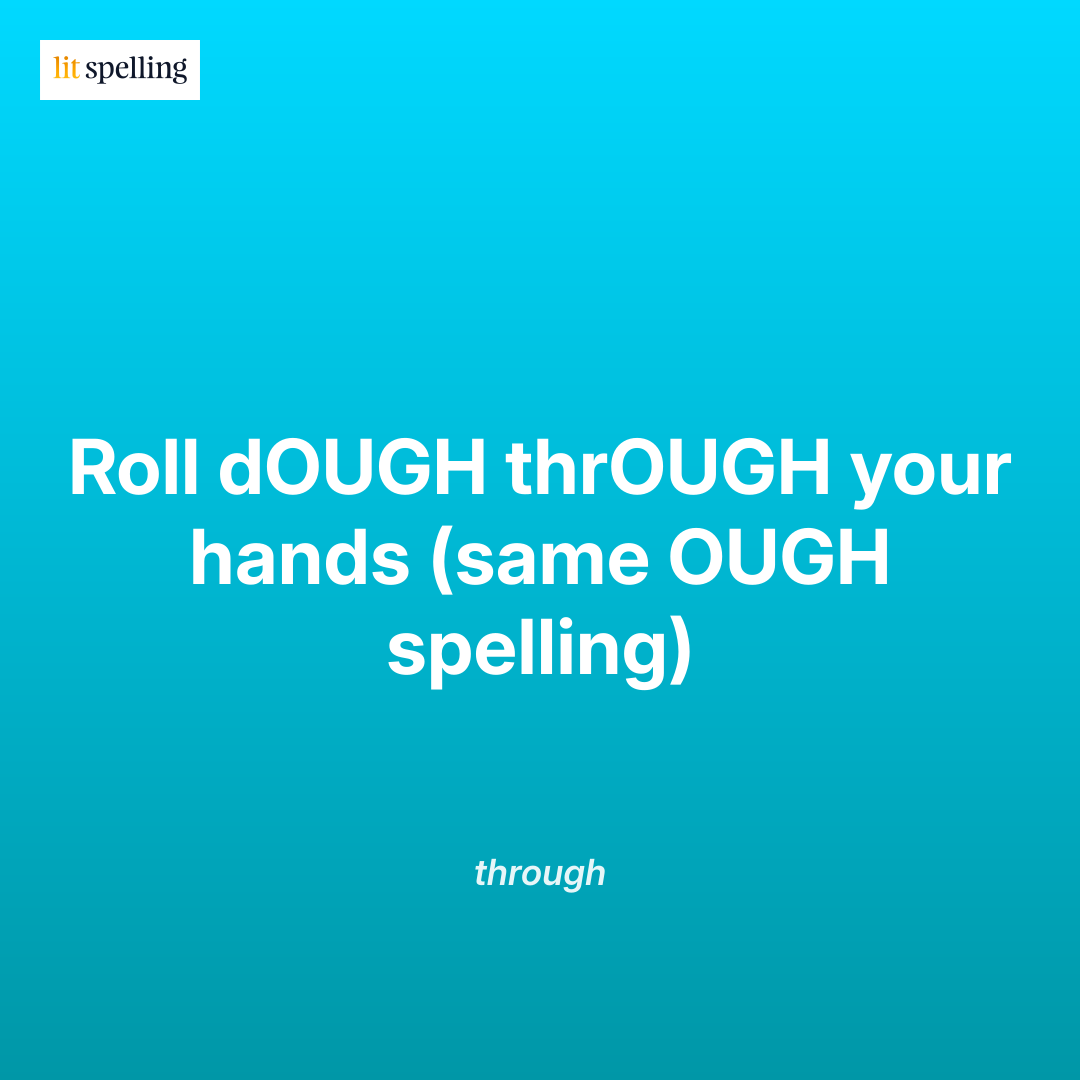
"Roll dOUGH thrOUGH your hands (same OUGH spelling)"
Why it works: Through is built from two familiar parts: TH (from "the") and ROUGH (r-o-u-g-h). The second half is just the word "rough" - a word you already know. This breaks a seven-letter puzzle into two easy parts and eliminates the phantom T error completely.
How to use it: When you reach the middle of "through," ask: "what comes after TH?" Answer: ROUGH. Write TH then spell out ROUGH: t-h-r-o-u-g-h. Done. No T at the end because ROUGH ends in H, not T.
What Through Means
Through means from one side to the other, or by means of - used to express movement, passage, or completion.
Movement: "She walked through the door without stopping."
Completion: "We worked through the night to finish the report."
Common Misspellings of Through
✗ throught - Adds a phantom T at the end, confused with thought/brought/fought
✗ trough - Swaps U and O; also a real word (an animal feeding trough), but a different one
✗ thru - Informal shorthand, acceptable in texts but not in formal writing
Quick tip: ROUGH ends in H, not T - and so does THROUGH. If you can spell "rough," you can spell "through."