
To vs Too vs Two: Never Confuse Them Again
Master all three in 2 minutes with the cookie mnemonic that 1,000+ writers use daily
Common Misspellings:
You're Not Alone
This is one of the most frequently searched spelling questions online. With three identical-sounding words and three completely different meanings, even experienced writers pause. The confusion is completely natural, but perfectly solvable with the right visual trick.
The Three Variants
| Word | Meaning | Memory Trick | Example |
|---|---|---|---|
| TO | Direction/purpose | Single O like gO | "going to the store" |
| TOO | Also/excessive | Double OO like “tOO many” | "too many cookies" |
| TWO | The number 2 | TW like TWenty | "two cookies" |
Why This Mistake Happens
Identical pronunciation: All three sound exactly the same (/tuː/). Your ear provides zero clues, so your brain must choose based purely on context. When you’re typing quickly, it’s easy to grab the wrong one.
Three unrelated jobs: One shows direction (to), one shows excess or addition (too), one is a number (two). Three completely different meanings with one shared sound equals confusion guaranteed.
Autocorrect stays silent: All three are legitimate words, so spellcheck won’t catch the error. You can write “I want too go to the store to buy to apples” and spellcheck stays quiet - even though all three uses are wrong.
Word Origin
TO: From Old English “tō” (in the direction of), which has always meant direction or purpose. This preposition traveled from Old English through Middle English to modern English, maintaining its core meaning across more than a thousand years.
TOO: Developed from “to” with added emphasis in Middle English. Originally written as “to” but pronounced with stress to mean “also” or “excessively.” The extra “o” was added in the 16th century to distinguish the emphatic meaning from the directional one.
TWO: From Old English “twā” (the number 2), which came from Proto-Germanic. The spelling with “w” preserves the original Germanic sound, even though modern pronunciation dropped the /w/ sound centuries ago.
All three converged to identical pronunciation (/tuː/) over time, but their different origins and spellings remained intact - creating the modern confusion among these common homophones.
Etymology Path:
Old English tō / tō (emphatic) / twā → Middle English to / too / two → Modern English to / too / two
The Mnemonic
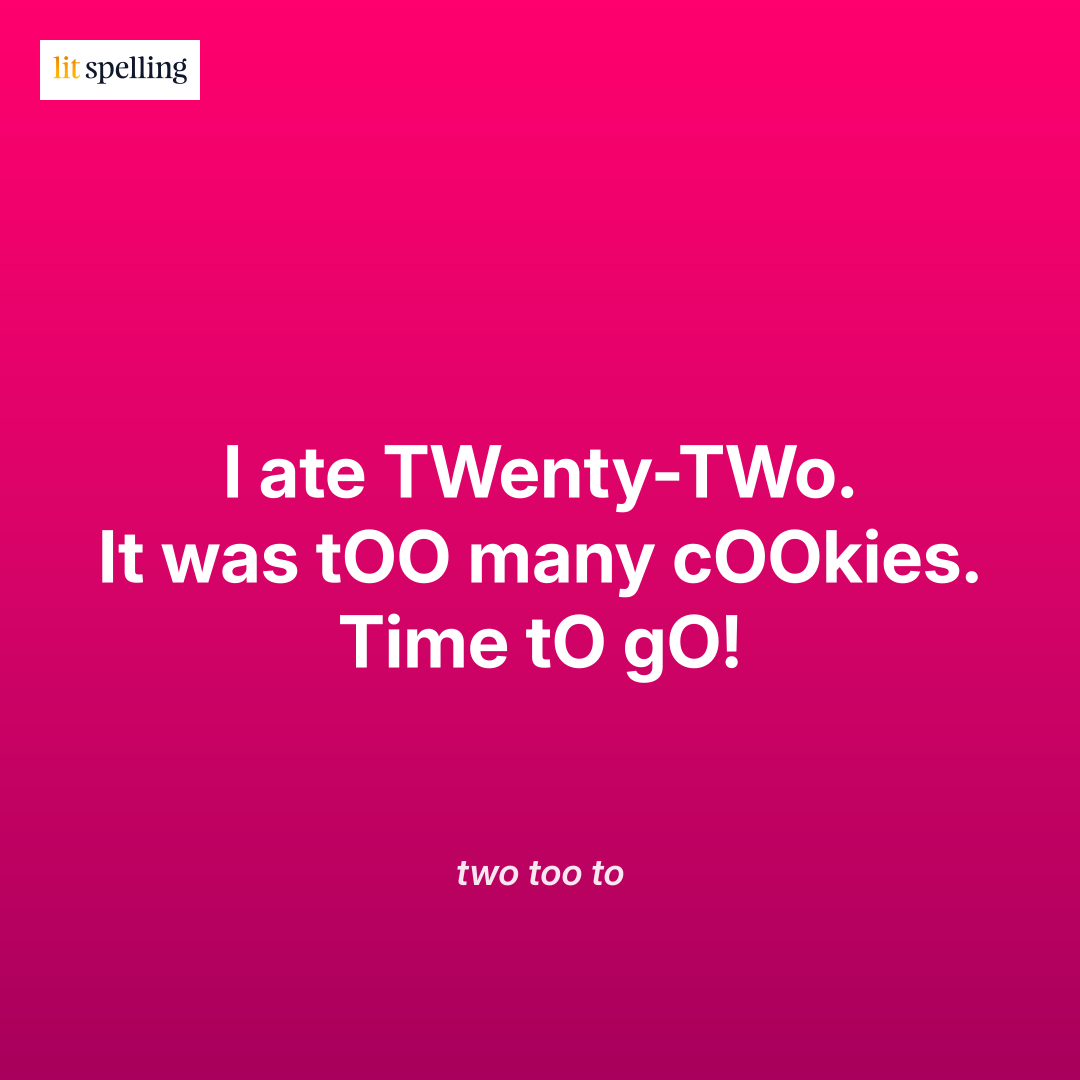
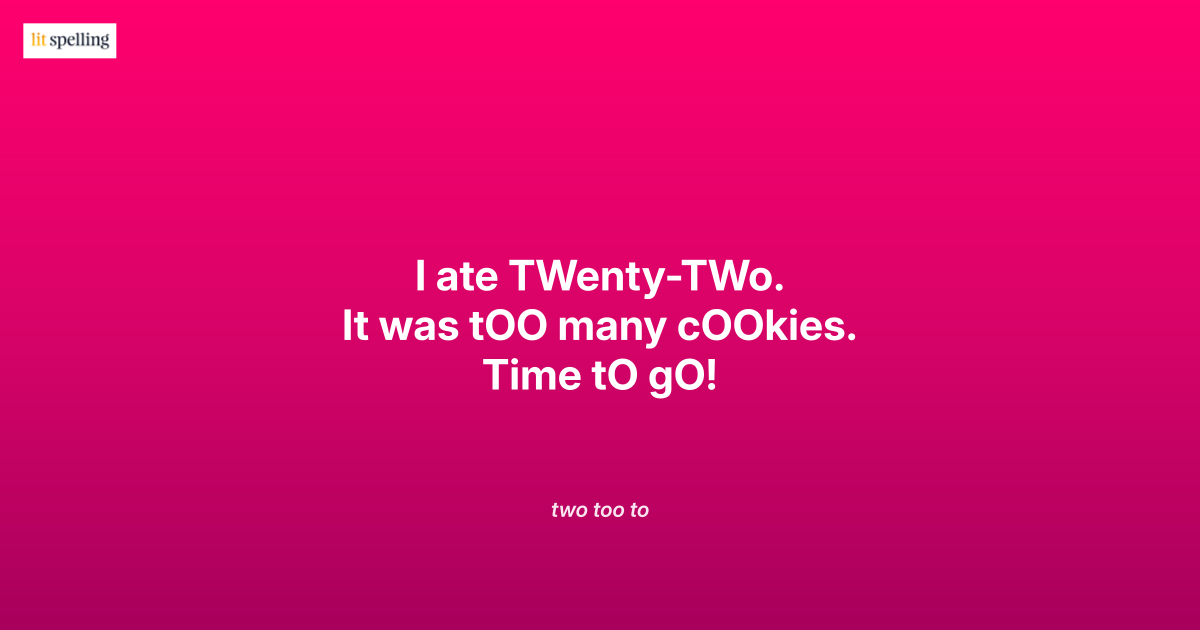
“I ate TWenty-TWo. It was tOO many cOOkies. Time tO gO! 🤢”
Why it works:
- TWO = Number: “I ate TWenty-TWo” - the letters TW appear in both TWenty and TWo. Visual: 22 cookies arranged on a plate. You’re counting a specific quantity.
- TOO = Excessive: “It was tOO many cOOkies” - the double OO appears in both tOO and cOOkies. Visual: Feeling sick from eating too much. The excess O’s match the excessive amount.
- TO = Direction: “Time tO gO” - the single O appears in both tO and gO. Visual: Running to the bathroom. You’re showing direction or purpose.
How to use it:
When you’re writing and pause at to/too/two, picture the cookie scene. Are you counting a number? (TWO has TW like TWenty). Talking about excess or addition? (TOO has double OO like tOO much). Or showing direction/purpose? (TO has single O like gO). The cookie scene gives you all three at once: a countable number (22), an excessive amount (too many), and a direction (to go).
Examples in Context
School: “I need to bring two pencils. That’s not too many.”
Home: “We’re going to the park at two o’clock. Can I come too?”
Work: “I have two meetings to attend. That’s too much for one day.”
Casual: “Want to grab lunch? I’m free at two. Sarah’s coming too.”
Story (Cookie Scene): “I ate two dozen cookies. It was too many. Time to go! 🤢”
Common Mistakes to Avoid
“I want too go home” → “I want to go home” (direction = single O like gO)
“I have to apples” → “I have two apples” (number 2 = TW like TWenty)
“This is to expensive” → “This is too expensive” (excessive = double OO like tOO much)
Quick tip: Replace the word with the number 2. If it makes sense, use TWO. If not, ask: is this about excess/addition (TOO with double OO) or direction/purpose (TO with single O)? The cookie mnemonic shows all three: TWenty-TWo (number), tOO many (excess), tO gO (direction).
Quick Reference
Frequently Asked Questions
Build Spelling Confidence with Daily Practice
You just mastered to/too/two in 2 minutes. Imagine mastering 100+ commonly confused words with our free Daily Challenge. 5 words delivered daily that adapt to your skill level - just like this cookie mnemonic approach.
Free forever. No credit card required.