
Where vs Wear: Never Confuse Them Again
One hides HERE. The other hides EAR. That's the whole trick.
Common Misspellings:

You're Not Alone
This is one of the most common homophone mix-ups in English. It appears in student writing, text messages, and even published work. The confusion is natural because both words sound identical and both are used constantly in everyday language.
The Two Variants
| Word | Meaning | Memory Trick | Example |
|---|---|---|---|
| WHERE | Asking about a place or location | WHERE has HERE inside it. Both are about location. | "Where is the library?" |
| WEAR | To put on clothing or accessories | WEAR has EAR inside it. You wear things on or near your ear. | "What should I wear today?" |
Why This Mistake Happens
Identical pronunciation: Both words sound exactly the same (/wɛər/). Your ear provides no clue, so your brain must choose the spelling based on meaning alone.
Both are everyday words: Where and wear appear in casual conversation constantly. When typing quickly, your fingers often default to whichever spelling comes to mind first.
Spellcheck can't help: Both are real words, so spellcheck won't flag "wear is the shop?" or "where your coat", even though both are wrong. You need to check meaning, not just spelling.
Word Origin
WHERE: From Old English “hwǣr” (at what place), related to “here” and “there.” It has always been a question word about location, carrying the same meaning for over a thousand years through Old English, Middle English, and into modern English.
WEAR: From Old English “werian” (to carry on the body, to put on). Originally it meant to carry or bear clothing, and it retains that core meaning today. The spelling shifted over centuries, but the connection to the body and clothing has remained constant.
Etymology Path:
Old English hwǣr / werian → Middle English wher / weren → Modern English where / wear
The Memory Trick
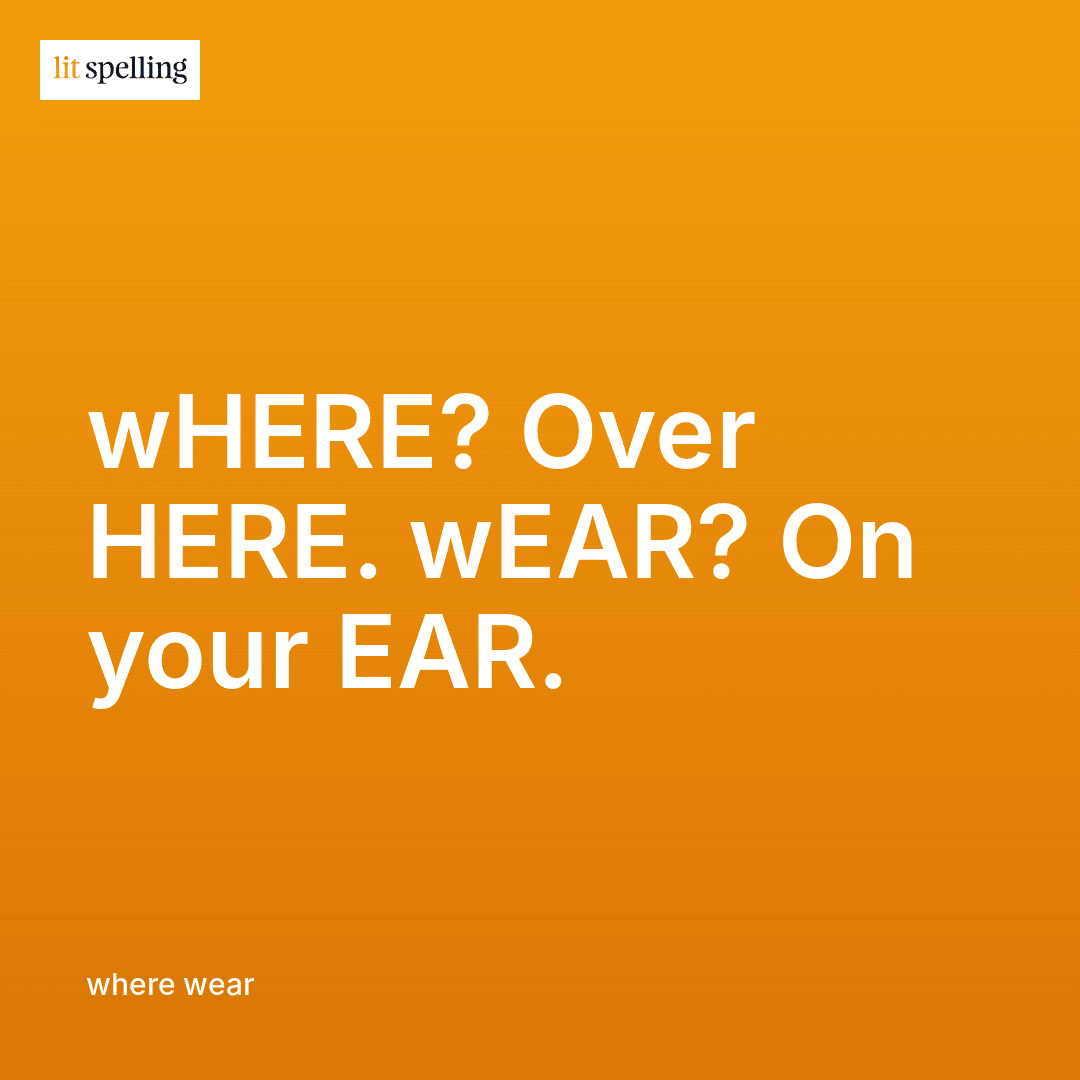
“wHERE? Over HERE. wEAR? On your EAR.”
Why it works:
- WHERE has HERE: Look inside w-HERE. The word HERE is about location, and WHERE asks about location. The hidden word matches the meaning perfectly.
- WEAR has EAR: Look inside w-EAR. You wear earrings on your EAR, you wear headphones over your EAR. The hidden word connects to the body, exactly what wearing is about.
How to use it:
Ask yourself: is this about a place? Look for HERE inside the word, use WHERE. Is this about clothing or the body? Look for EAR inside the word, use WEAR. The hidden words never lie.
Examples in Context
School: “Do you know where the gym is? You need to wear your sports uniform today.”
Work: “I’m not sure where the meeting is, but you should wear something professional.”
Casual: “Where did you get that jacket? I’d wear that every day!”
Common Mistakes to Avoid
“Wear is the shop?” → “Where is the shop?” (asking about a place = WHERE (has HERE))
“Where your seatbelt” → “Wear your seatbelt” (putting something on = WEAR (has EAR))
“I don't know wear to go” → “I don't know where to go” (location = WHERE (has HERE))
Quick tip: Look inside the word. WHERE has HERE (location). WEAR has EAR (body/clothing). The hidden word tells you the meaning.