
Your vs You're: Never Confuse Them Again
One has a crack. One is solid. That's the whole trick.
Common Misspellings:

You're Not Alone
This is the single most common homophone error in English. It appears in texts, emails, social media posts, and even professional documents. The confusion is completely natural. Both words sound identical and both are among the most frequently used words in the language.
The Two Variants
| Word | Meaning | Memory Trick | Example |
|---|---|---|---|
| YOUR | Possession/ownership | YOUR shows something belongs to you | "Is this your coat?" |
| YOU'RE | Contraction of "you are" | YOU’RE = YOU ARE (apostrophe marks the missing “a”) | "You're welcome" |
Why This Mistake Happens
Identical pronunciation: Both words sound exactly the same (/jʊər/ or /jɔːr/). Your ear provides zero guidance, so your brain must choose based on meaning alone.
Speed of typing: Both words are extremely common. When typing quickly, your fingers often reach for the shorter or more familiar spelling before your brain catches up.
Autocorrect stays silent: Both are real words, so spellcheck won't flag "your welcome" or "you're coat," even though both are wrong. You need a human check (or the "you are" test).
Word Origin
YOUR: From Old English “ēower” (of you, belonging to you), the possessive form of “you.” It has always indicated ownership, traveling unchanged in meaning from Old English through Middle English to today.
YOU’RE: A contraction that emerged in the 17th century as informal English shortened “you are” into a single word. The apostrophe marks where the “a” was dropped, a convention that applies to all English contractions (I’m, they’re, we’re).
Etymology Path:
Old English ēower / you are → Middle English your / you are → Modern English your / you're
The Memory Trick
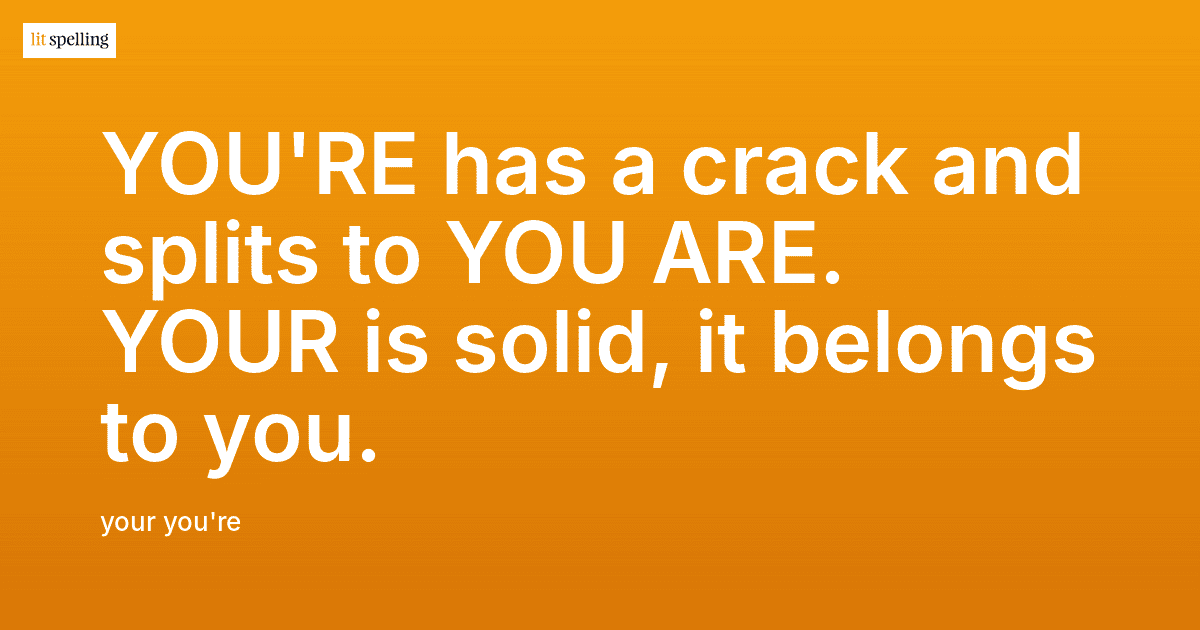
“YOU'RE has a crack and splits to YOU ARE. YOUR is solid, it belongs to you.”
Why it works:
- YOU’RE has a crack: The apostrophe is a visible crack in the word. It splits apart into two pieces: YOU + ARE. If you can split it and it makes sense, you need the cracked version.
- YOUR is solid: No crack, no split. It’s one solid word that holds onto something. “Your coat, your idea, your turn.” It’s solid because it belongs to you.
How to use it:
Look at the word: does it need a crack? Try splitting it into “you are.” If “you are late” sounds right, use the cracked version, YOU’RE. If “you are bag” sounds wrong, use the solid version, YOUR.
Examples in Context
School: “Don’t forget your homework. You’re going to need it for the test.”
Work: “You’re invited to the meeting about your project update.”
Casual: “Is that your dog? You’re lucky, he’s adorable!”
Common Mistakes to Avoid
“Your welcome” → “You're welcome” (you ARE welcome = YOU'RE)
“You're coat is here” → “Your coat is here” (ownership = YOUR, no apostrophe)
“Your going to love it” → “You're going to love it” (you ARE going = YOU'RE)
Quick tip: Replace with "you are." If it makes sense, use you're (with apostrophe). If not, use your (no apostrophe).