
How to Spell Rhythm
Is it rhythem, or rhythm?
The correct spelling is rhythm - 6 letters, only one vowel (Y), no E anywhere. It's commonly misspelled as rhythem, rythem, or rythm.
Rhythm is a strong, regular, repeated pattern of sounds or movement, fundamental to music, poetry, speech, and dance.
Common Misspellings:
Why Rhythm Is Hard to Spell
You're not alone. Rhythm is famously one of the strangest spellings in English - a word with almost no vowels that looks nothing like it sounds. It appears on nearly every "hardest words to spell" list, and for good reason: six letters, only one vowel (Y), and two consonant clusters (RH- and -TH-) that rarely appear in English words.
Why this mistake happens: English words almost never end in "-thm" without a following vowel, so the brain inserts a phantom E to make "rhythem" feel natural. The RH- opening is also rare (mainly in Greek-origin words like "rhyme" and "rhetoric"), so many people drop the H and write "rythm" or "rythem." Every instinct about English phonics leads away from the correct spelling.
Rhythm Spelling Breakdown
Break it into clusters: RH-Y-TH-M
Six letters, one vowel. The RH opening is Greek (like "rhyme," "rhetoric"). The Y is the only vowel. The TH is followed immediately by M - no E in between. Think of it as two consonant pairs with a Y in the middle: RH-Y-TH-M.
Word Origin
"Rhythm" comes from Greek "rhythmos" (measured motion, regulated flow), derived from "rhein" (to flow). The word entered English via Latin "rhythmus" and Old French "rithme" in the 14th century, initially in musical and poetic contexts. The unusual RH- at the start preserves the Greek spelling convention for a particular R sound - the same convention seen in "rhyme," "rhetoric," "rhinoceros," and "rhapsody." English kept the Greek spelling almost entirely intact, which is why the word looks so different from how it sounds.
Etymology Path:
Greek rhythmos → Latin rhythmus → Modern English rhythm
Memory Trick for Rhythm
Use this acrostic to spell it perfectly, every time:
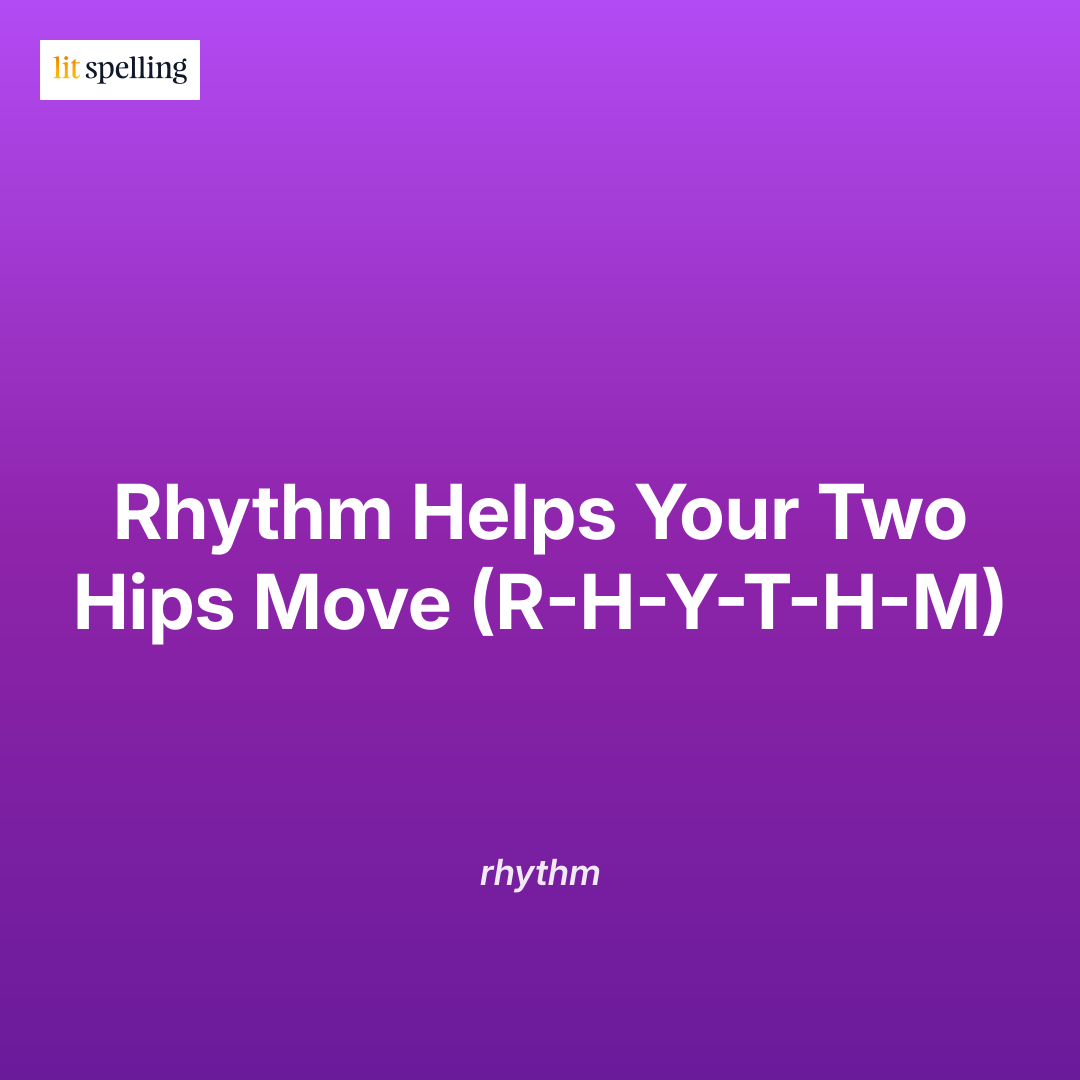
"Rhythm Helps Your Two Hips Move - R.H.Y.T.H.M"
Why it works: This is an acrostic - each word in the phrase starts with a letter of RHYTHM: Rhythm Helps Your Two Hips Move. The phrase describes exactly what rhythm does - so it reinforces both the meaning and the spelling simultaneously. You never have to memorise the sequence; just recall the sentence and read the first letters.
How to use it: When you need to spell "rhythm," say the phrase in your head: "Rhythm Helps Your Two Hips Move." Read off the first letter of each word: R-H-Y-T-H-M. Six letters, no E, no exceptions. The physical image of hips moving in rhythm also makes the mnemonic harder to forget.
What Rhythm Means
Rhythm is a strong, regular, repeated pattern of sounds or movement, fundamental to music, poetry, speech, and dance.
Music: "The drummer's steady rhythm held the entire band together through the final chorus."
Poetry: "Emily Dickinson's poems have an unmistakable rhythm and internal rhyme that makes them instantly easy to spot."
Common Misspellings of Rhythm
✗ rhythem - Phantom E added after TH (inserting a vowel that doesn't exist - the most common error)
✗ rythem - Missing H from RH AND phantom E added (two errors: "rh" becomes "r" and phantom E appears)
✗ rythm - Missing H from the opening "RH" (writing just "r" instead of the Greek "rh" combination)
Quick tip: Recall "Rhythm Helps Your Two Hips Move" - R-H-Y-T-H-M. Six letters, only one vowel (Y). No E anywhere. The acrostic removes all guesswork.
