Brake vs Break: Never Confuse Them Again
brAKE to mAKE. brEAK to snEAK.
Common Misspellings:
You're Not Alone
Brake and break are among the most commonly confused homophones in English. The mix-up appears in school essays, text messages, workplace emails, and even published writing. The confusion is entirely natural. Both words sound identical and differ by only one letter.
The Two Variants
| Word | Meaning | Memory Trick | Example |
|---|---|---|---|
| BRAKE | To slow down or stop (device on a vehicle) | brAKE has AKE, rhymes with mAKE (make it stop) | "Hit the brake before the red light." |
| BREAK | To shatter, split, or take a pause | brEAK has EAK, rhymes with snEAK (sneak a rest) | "Let's take a break after this chapter." |
Why This Mistake Happens
Identical pronunciation: Both words sound exactly the same (/breɪk/). Your ear provides zero guidance, so your brain must choose based on meaning alone.
One-letter difference: BRAKE and BREAK differ by a single letter swap (A vs EA). When typing quickly, it's easy to reach for the wrong spelling before your brain catches up.
Autocorrect stays silent: Both are real words, so spellcheck won't flag "hit the break" or "take a brake", even though both are wrong. You need a meaning check.
Word Origin
BRAKE: From Middle Dutch “braeke” (a device for crushing or restraining), related to Old French “brac” (arm). Originally referred to a mechanism for stopping a wheel or cart. The sense of “slowing down” developed naturally from the physical restraining device.
BREAK: From Old English “brecan” (to shatter, burst, or fracture), with roots in Proto-Germanic “*brekan.” It has carried the core meaning of “coming apart” for over a thousand years. The sense of “taking a break” (a pause) comes from the idea of breaking a continuous activity.
Etymology Path:
Middle Dutch / Old English braeke / brecan → Middle English brake / breken → Modern English brake / break
The Memory Trick
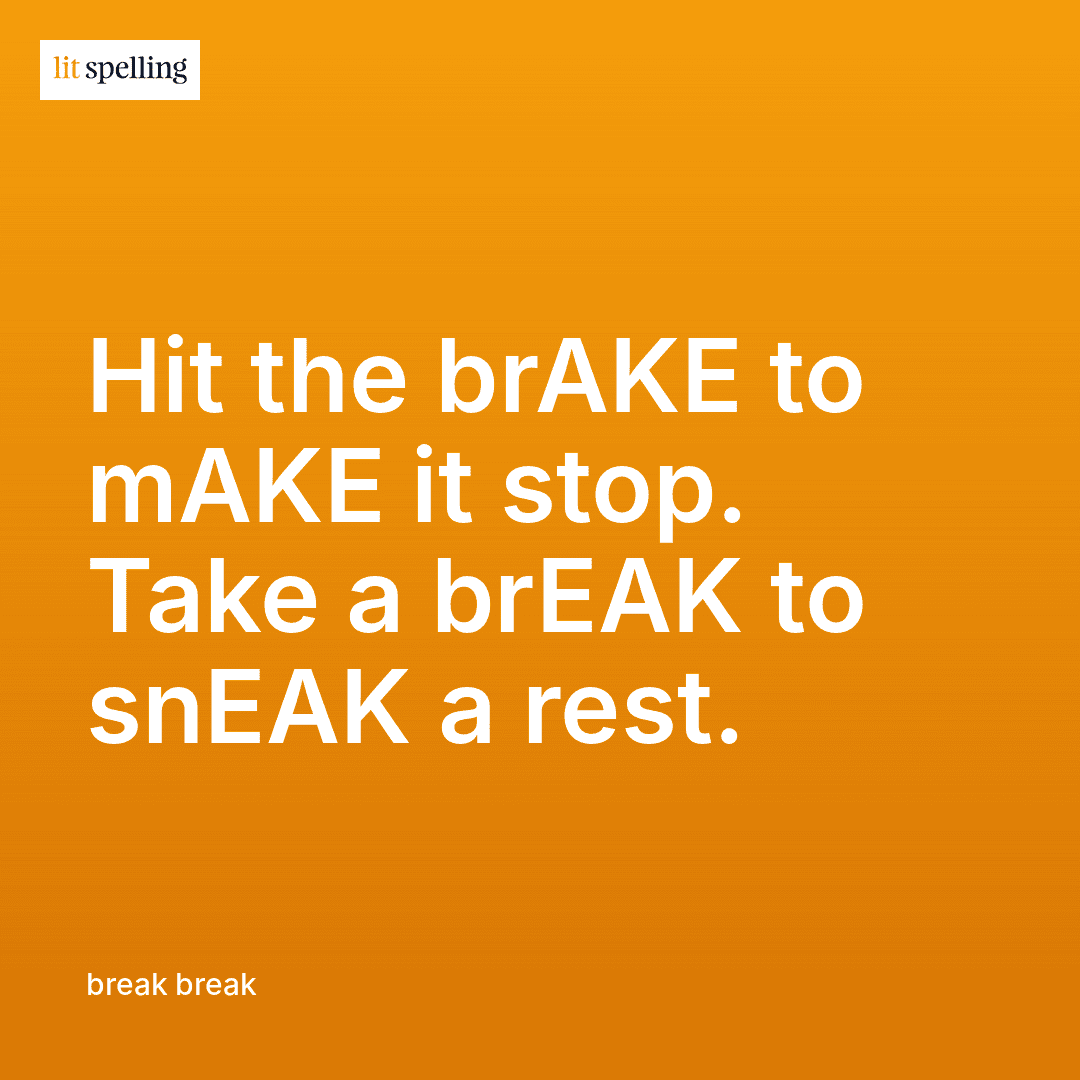
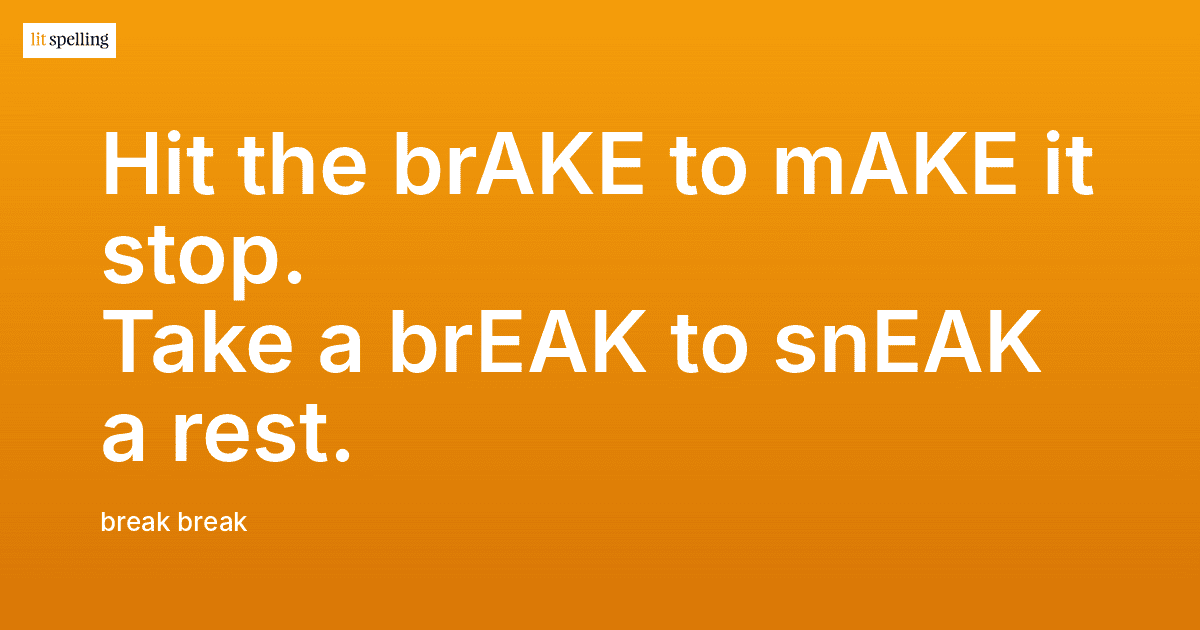
“Hit the brAKE to mAKE it stop. Take a brEAK to snEAK a rest.”
Why it works:
- brAKE → mAKE: Both share the “AKE” pattern. “Make it stop” connects directly to what a brake does, because it stops things. If you’re stopping, you need the AKE spelling.
- brEAK → snEAK: Both share the “EAK” pattern. “Sneak a rest” connects to taking a break, meaning a pause or interruption. If something is splitting apart or you’re pausing, you need the EAK spelling.
How to use it:
Think about the meaning: are you stopping motion? That’s brAKE (mAKE it stop). Are you shattering something or taking a rest? That’s brEAK (snEAK a rest). The rhyming pairs lock the spelling to the meaning.
Examples in Context
School: “Don’t forget to brake at the corner. We’ll take a break when we get to school.”
Work: “The forklift’s brake needs fixing. Let’s break for lunch while they repair it.”
Casual: “I had to brake hard to avoid the pothole. Almost gave myself a break in concentration!”
Common Mistakes to Avoid
“Hit the break pedal” → “Hit the brake pedal” (stopping = BRAKE (AKE = mAKE it stop))
“Take a brake from studying” → “Take a break from studying” (pausing = BREAK (EAK = snEAK a rest))
“The break pads are worn” → “The brake pads are worn” (vehicle part = BRAKE (the stopping device))
Quick tip: Stopping? brAKE (mAKE it stop). Shattering or resting? brEAK (snEAK a rest).