
Principal vs Principle: Never Confuse Them Again
AL = A Leader. LE = a ruLE. That's the whole trick.
Common Misspellings:
You're Not Alone
This is one of the most commonly confused word pairs in English. Both words are spelled almost identically, sound exactly the same, and share the same Latin root. The mix-up appears in essays, business writing, and everyday communication, and spellcheck won't catch it because both are real words.
The Two Variants
| Word | Meaning | Memory Trick | Example |
|---|---|---|---|
| PRINCIPAL | Head of a school, or the main/primary thing | PrincipAL ends in AL, meaning A Leader | "The principal announced a snow day." |
| PRINCIPLE | A fundamental rule, belief, or value | PrinciplE ends in LE, like a ruLE | "Honesty is an important principle." |
Why This Mistake Happens
Identical pronunciation: Both words sound exactly the same (/ˈprɪnsəpəl/). Your ear gives you zero help, so you have to rely on meaning and spelling alone.
One-letter difference: The only visual difference is the final vowel, AL vs LE. When writing quickly, it's easy to grab the wrong ending without noticing.
Autocorrect stays silent: Both are real words, so spellcheck won't flag "the principle of the school" or "a matter of principal," even though both are wrong. You need the AL/LE trick.
Word Origin
PRINCIPAL: From Latin “principalis” (first in importance), derived from “princeps” (first, chief). It entered English through Old French and has always carried the sense of “main” or “chief,” whether describing a person in charge or the most important element.
PRINCIPLE: From Latin “principium” (origin, foundation, beginning), also from “princeps.” It arrived through Old French “principe” and has always meant a foundational rule or truth. It refers to the starting point from which other ideas follow.
Etymology Path:
Latin principalis / principium → Old French principal / principe → Modern English principal / principle
The Memory Trick
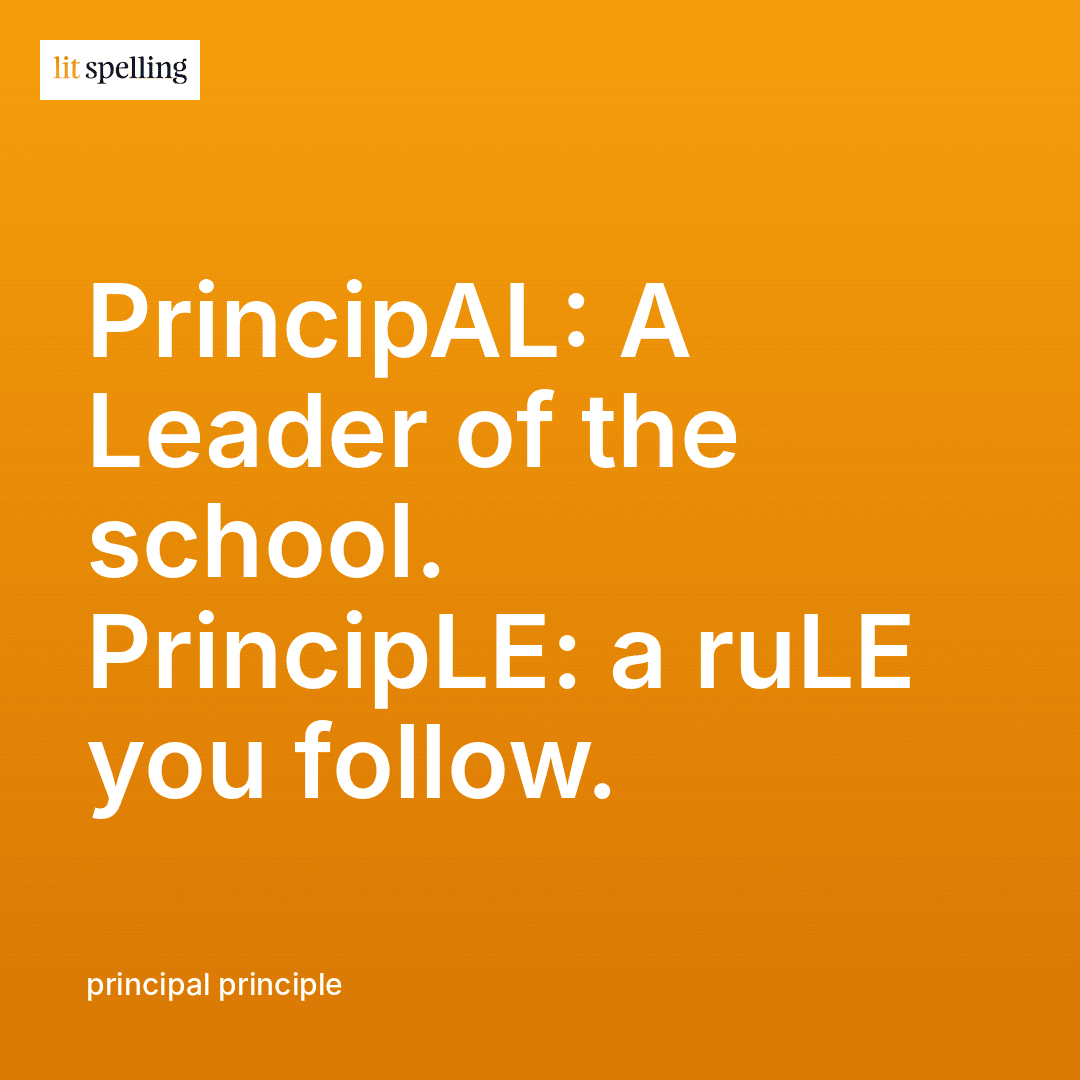
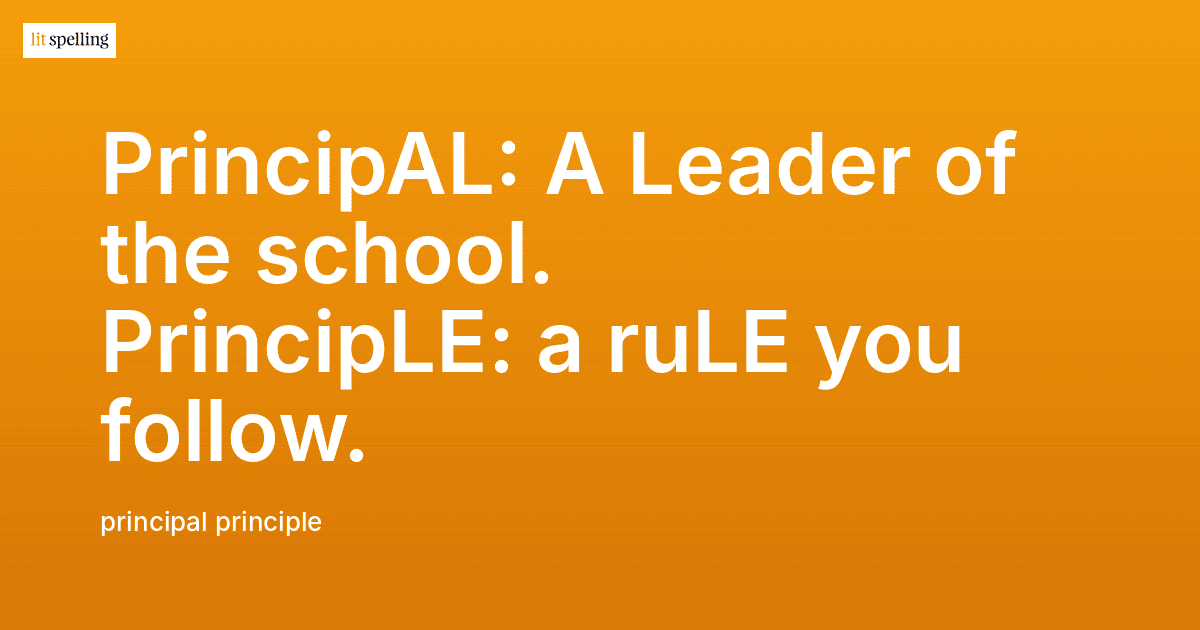
“PrincipAL: A Leader of the school. PrincipLE: a ruLE you follow.”
Why it works:
- PrincipAL ends in AL, meaning A Leader: The letters A and L at the end spell out “A Leader.” The principal of a school is a leader, and when something is the “principal reason,” it’s the leading reason.
- PrinciplE ends in LE, like a ruLE: The letters L and E at the end appear in the word “rule.” A principle is a rule you follow, whether a belief, a value, or a law of nature.
How to use it:
When you’re unsure, look at what you mean. Are you talking about a person in charge or the main thing? Use principAL (A Leader). Are you talking about a rule, belief, or value? Use principlE (a ruLE). The ending tells you everything.
Examples in Context
School: “The principal reminded students that respect is a key principle of the school.”
Work: “Our principal concern is staying true to the principles we built this company on.”
Casual: “I won’t do it. It’s a matter of principle. Even the principal agreed with me.”
Common Mistakes to Avoid
“The principle of the school” → “The principal of the school” (a person/leader = principAL (A Leader))
“A matter of principal” → “A matter of principle” (a rule/belief = principlE (a ruLE))
“The principal of gravity” → “The principle of gravity” (a law of nature = principlE (a ruLE))
Quick tip: PrincipAL = A Leader (person or main thing). PrinciplE = a ruLE (belief or value). Check the ending.