
Won vs One: Never Confuse Them Again
W is for Win. ON is for ONly ONe.
Common Misspellings:
You're Not Alone
Won and one are among the trickiest homophones because they look nothing alike. The confusion is entirely based on identical pronunciation. Young spellers, English learners, and even fluent writers mix them up when writing quickly because the brain hears one sound and has to choose between two very different spellings.
The Two Variants
| Word | Meaning | Memory Trick | Example |
|---|---|---|---|
| WON | Past tense of "win" (victory) | WON starts with W, as in W for Win | "She won the spelling bee." |
| ONE | The number 1, or a single item | ONE has ON, as in ONly ONe | "There's only one cookie left." |
Why This Mistake Happens
Identical pronunciation: Both words sound exactly the same (/wʌn/). Your ear hears one single sound, giving you zero clues about which spelling to reach for.
No visual similarity: Unlike most homophones that share some letters, won and one look completely different. There's no shared pattern to anchor to, so you must rely on meaning alone.
Autocorrect stays silent: Both are real, common words, so spellcheck won't flag "I one the game" or "only won left," even though both are wrong. You need a meaning check, not a spell check.
Word Origin
WON: From Old English “winnan” (to strive, fight, win). The past tense form “won” has been used since Middle English. The word has always been tied to effort and victory. You win by striving, and won records that achievement.
ONE: From Old English “ān” (one, single), which is also the ancestor of the indefinite article “a/an.” The modern pronunciation shifted over centuries. The spelling preserved the older form while the spoken word changed, which is why ONE doesn’t sound like it looks.
Etymology Path:
Old English winnan / ān → Middle English wonnen / oon → Modern English won / one
The Memory Trick
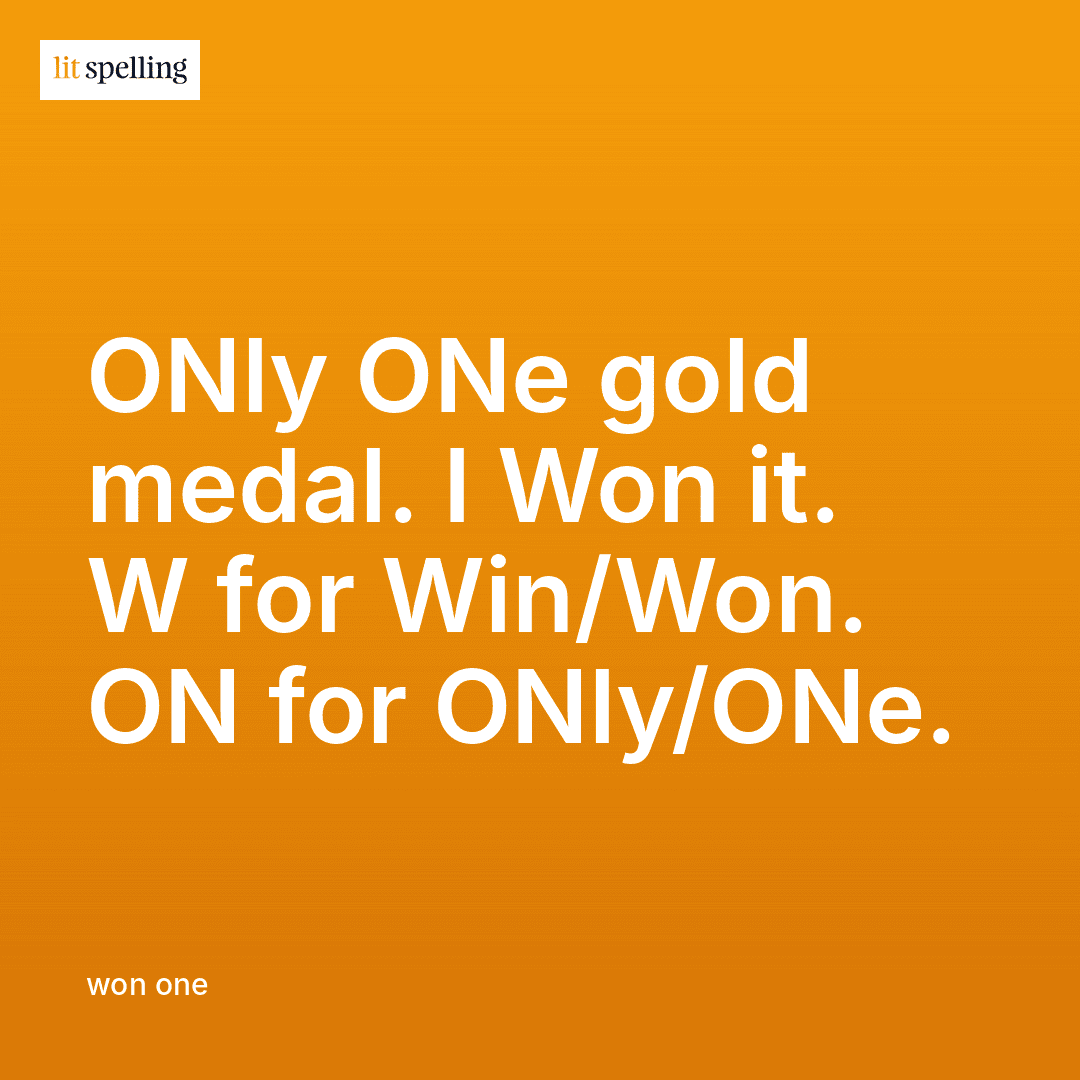
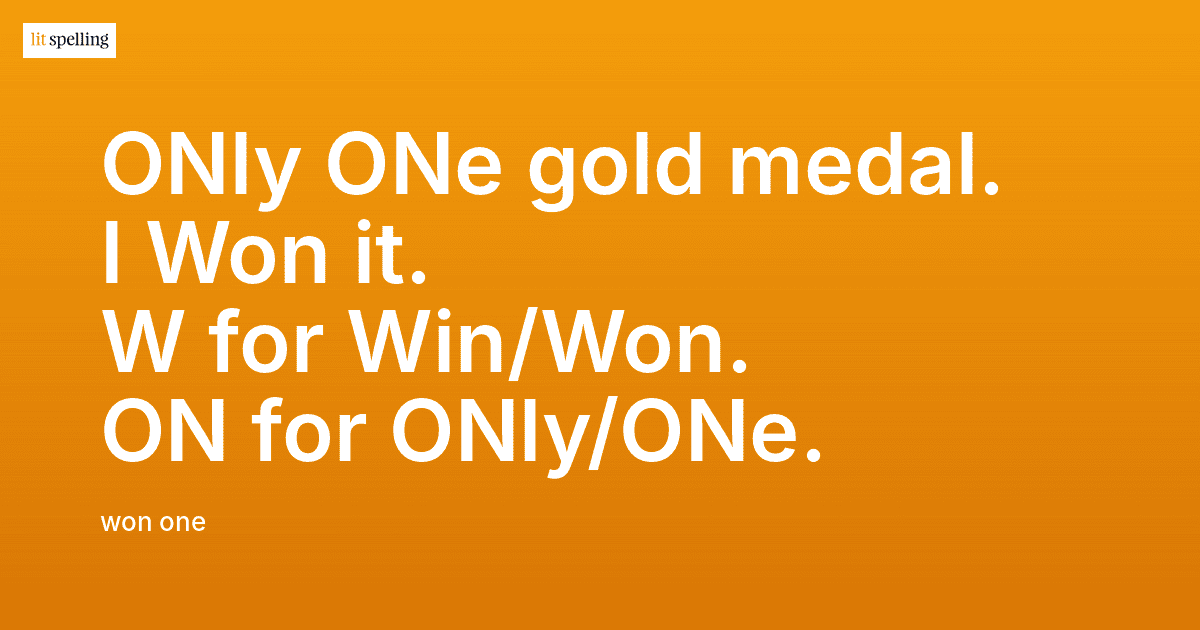
“ONly ONe gold medal. I Won it. W for Win/Won. ON for ONly/ONe.”
Why it works:
- WON starts with W: W is for Win. If you’re talking about victory, winning, or achieving something, you need the word that starts with W. WON. Win and Won share that same starting letter.
- ONE contains ON: ON is for ONly ONe. If you’re talking about a number or a single item, you need the word with ON inside it. ONE. The letters ON appear in ONly and ONe, linking them together.
How to use it:
Ask: am I talking about winning or about a number? If it’s victory, think W for Win → WON. If it’s a quantity or single item, think ONly ONe → ONE. Picture one gold medal. There’s ONly ONE, and someone WON it.
Examples in Context
School: “Our team won the relay race by one second.”
Work: “We won the contract, and it was the one we’d been chasing all quarter.”
Casual: “She won every round except one.”
Common Mistakes to Avoid
“I one the game” → “I won the game” (victory = WON (W for Win))
“Only won cookie left” → “Only one cookie left” (a number = ONE (ONly ONe))
“She one first place” → “She won first place” (winning = WON (W for Win))
Quick tip: Winning? Use WON (W for Win). A number? Use ONE (ONly ONe).